This material (including images) is copyrighted!. See my copyright notice for fair use practices. Select the photographs to display the original source in another window. Links to external sites will be displayed in another window.
George Gamov (lived 1904–1968) predicted in 1948 that there should be a faint glow left over from when the universe was much hotter and denser. Since the universe is observed to be expanding, it means that the galaxies were originally right on top of each other. Also, the energy of the universe was concentrated in a smaller volume. The entire universe would have glowed first in the gamma ray band, then the X-ray band, then to less energetic bands as the universe expanded. By now, about 13.8 billion years after the start of the expansion, the cold universe should glow in the radio band. The expansion rate has slowed down over time because of the force of gravity. This means that the early expansion was faster than it is now. At the start of the expansion, the expansion rate was extremely rapid.
The early large expansion rate and very hot temperatures made Fred Hoyle (lived 1915–2001) call this theory of the birth of the universe, the Big Bang. At the time he coined the term, Hoyle was advocating another theory that used the perfect cosmological principle called the Steady State theory. So at the time, Hoyle's “Big Bang” term was made in joking disdain. However, the Big Bang proponents liked the term and used it from then on.
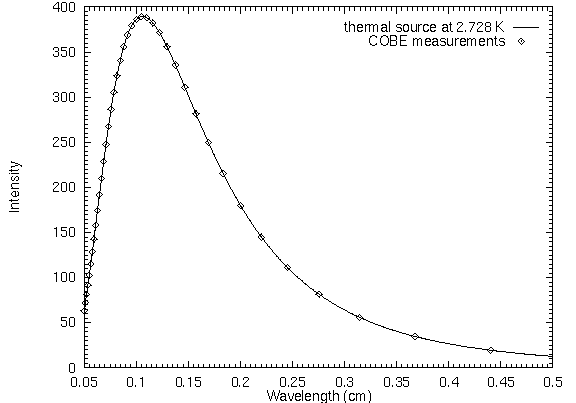
Arno Penzias and Robert Wilson observed in 1965 a radio background source that was spread all over the universe---the cosmic microwave background radiation. The radiation has the same intensity and spectral character as a thermal continuous source at 3 K (more precisely, 2.728 ± 0.004 K) as measured by the COBE satellite in every direction observed. To a high degree of precision the sky is uniformly bright in radio. The uniformity of the background radiation is evidence for the cosmological principle. The error bars in the figure below are too small to be seen.
This background radiation is interpreted to be the relic of the early universe. If this is correct, then the early universe was very uniform. Since the further out in space you look means the further back in time you look, the microwave radiation is coming from the universe as it was a few hundred thousand years after the Big Bang when the universe was much hotter. The glow from the early hot universe has been redshifted by 1100 times! Hoyle's Steady State theory could not adequately explain the presence of the background radiation and so was abandoned by most astronomers.
Let's take a closer look at what was happening in the universe when it produced the background radiation. The early universe (both the matter and the radiation) was much more compact. The radiation density was so great that it dominated the expansion rate and the conditions of the universe for the first 10,000 years. Remember Einstein's equation relating energy and mass? The energy E=mc2 so the radiation energy had a definite gravitational effect!
The early universe was hot and opaque (photons could not move very far before being absorbed). The freely-moving electrons, protons, and neutrons scattered the photons all about making the dense gas opaque. Dense hot gases will produce a continuous spectrum that depends only on the temperature (a thermal spectrum). The universe cooled off as it expanded. Eventually, the early universe cooled to where the electrons and protons could combine to form neutral hydrogen atoms and not be blown apart by energetic photons. The process of the electrons becoming bound to the protons to make atoms is called recombination. Okay, “recombination” is not really correct since this was the first time that the electrons combined with the protons, but the term also describes processes that occur today. Extrapolating the expansion rate and the temperature of the universe backward in time, one finds that at the temperature of 3000 K, the universe was about 380,000 years old.
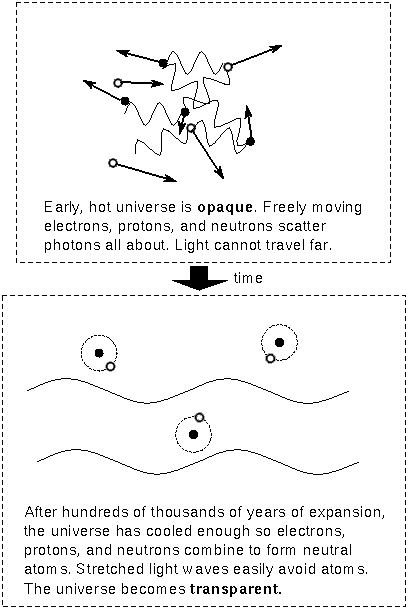
At the time of recombination, the number of unit particles was cut at least in half (one electron + one proton become a single atom; the neutrons also were incorporated into the atoms). That meant the photons could travel further without hitting some kind of unit particle. Also, the expansion of the universe spread the matter out. In addition, the coolness of the universe (only 3000 K at the time of recombination) meant that longer wavelengths of light were present. Instead of the gamma rays and X-rays of earlier times, the predominant form of radiation was the longer wavelength visible light and infrared. Longer wavelengths of light are able to more easily to pass through gas. For all of these reasons the photons could then travel long distances without running into some particle. The universe became transparent when the universe was glowing at the temperature of the surface of a cool star. The photons from this time are now reaching our radio telescopes. They are by far the oldest radiation that can be detected.
[There were also helium nuclei (nuclei with 2 protons plus 1 or 2 neutrons) and the electrons became bound to them in two stages with the first electron of the helium atom becoming bound at redshifts around 6000, corresponding to about 18,000 years after the Big Bang and the second electron of the helium atom becoming bound (to make neutral helium) at redshifts around 2000, corresponding to about 131,000 years after the Big Bang. However, the hydrogen was far more abundant than the helium and hydrogen's later recombination time means the universe was still opaque when helium became neutral atoms. You can use Ned Wright's Javascript Cosmology Calculator to convert a given redshift to an age of the universe.]
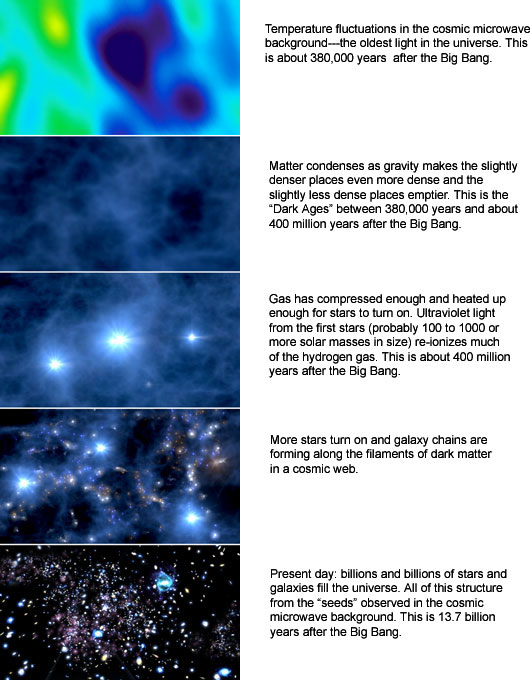
The universe could not have been perfectly uniform, though. The universe must have been slightly lumpy to form galaxies and people later on from the internal gravity of the lumps. Gravity is symmetrical so it needed some initial density variations to provide some direction to where surrounding matter could be attracted. The COBE satellite found slight variations in the brightness of the background radiation of about 1 part in 100,000. The slight variations exist because some parts of the universe were slightly denser than other parts. The slightly denser regions had more gravity and attracted more material to them while the expansion occurred. Over time, the denser regions got even denser and eventually formed galaxies about 1 billion years after the Big Bang. The slightly less dense places got even emptier as gravity increased the contrast between the denser places and less dense places. See the figure at the end of the superclusters section for a simulation of this process.
Below is a sequence of false-color microwave all-sky maps from the Differential Microwave Radiometer (DMR) instrument on the COBE satellite. The galactic equator runs horizontally through the center of each map. The range of temperatures for each map is given in the caption.

The colors for the temperatures range from blue for 0 K to red for 4 K (yes, the color scheme is backward---blue should be hot and red should be cool). Notice that the background appears completely uniform at a temperature of 2.728 K.
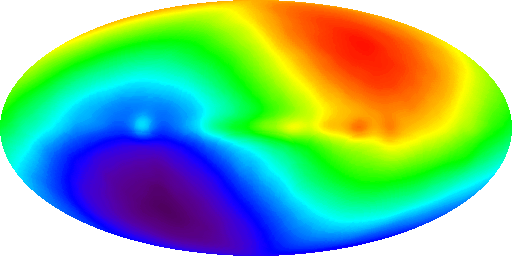
The colors for the temperatures range from blue for 2.724 K to red for 2.732 K. The double-lobe pattern shows the doppler effect from the motion of the Sun with respect to the background radiation. You see our motion with respect to the rest frame of the microwave background. The background appears about 1/1000 times hotter (redder in this false-color map) in the direction the Sun is moving toward and about 1/1000 times cooler (bluer here) in the direction the Sun is moving away from.
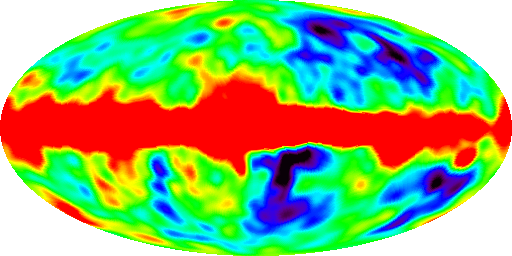
The colors for the temperatures range from blue for 2.7279 K to red for 2.7281 K. The effect of the Sun's motion has been subtracted out leaving fluctuations that are thirty times smaller than the previous map. The faint microwave contribution of the Milky Way is clearly seen along the center. The Cygnus constellation is at left center, the Sagittarius constellation is at the center, and the Orion constellation is at right center.
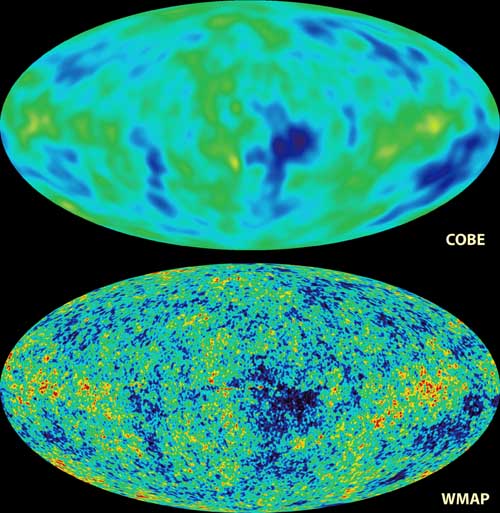
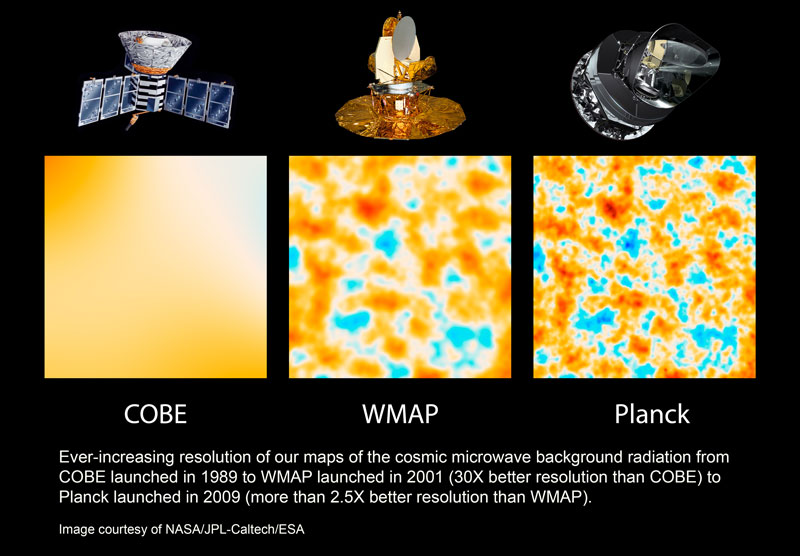
Below is a picture of the fluctuations in the background radiation when the Milky Way's contribution is subtracted out. It shows a comparison of the coarse resolution of COBE with the finer resolution of the Wilkinson Microwave Anisotropy Probe (WMAP). WMAP had over 30 times greater resolution than the COBE satellite. With that greater resolution WMAP enabled us to learn the composition, geometry, and history of the universe, amount of matter in the universe, as well as, it provided much tighter constraints on the models. Selecting the map below will take you to the WMAP homepage in another window.
The follow-up to WMAP is the Planck mission with over 2.5 times greater resolution than WMAP. The first data release in early 2013 confirmed the standard cosmology model derived from the COBE and WMAP missions but it did show some surprises at the really large scales (6 to 90 degrees across) with slightly weaker than expected fluctuations at those scales and also an asymmetry in the temperature fluctuations across the two halves of the sky, where one hemisphere has a wider variation in the fluctuations than the other hemisphere. In the past, advances in technology led to breakthroughs in our understanding of the nature of the universe and the high-precision measurements of Planck may be indicating a need to modify the standard cosmology model.
The time period between when the universe became transparent about 380,000 years after the Big Bang and formation of the first stars in the galaxies and the large black holes in the quasars began flooding the universe with powerful ultraviolet is called the “Dark Ages” or “Dark Era” in cosmological models. The ultraviolet light re-ionized the gas, freeing a lot of electrons. The transition period from the Dark Ages to the modern universe is called the “Epoch of Reionization” or “Reionization Era”. The light from the cosmic background would scatter off these newly freed electrons and become “polarized” so that the light waves tend to oscillate in a particular direction. How the light is polarized can tell you when the electrons were being freed again, i.e., when the stars first began to shine.
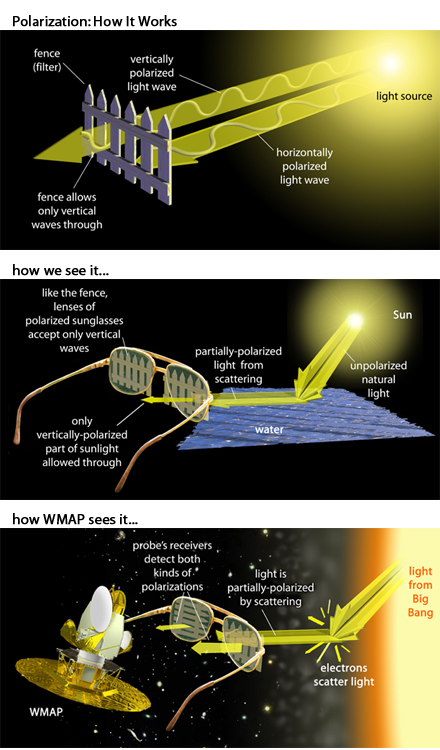
WMAP has detected the polarization of the microwave background and derived a time of about 400 million years after the Big Bang for the first stars but the higher resolution data of Planck puts the time at about 560 million years after the Big Bang. The Reionization Era is thought to take place between about 560 million years to about 1 billion years after the Big Bang. The visible light from these first stars will now have been redshifted into the infrared.
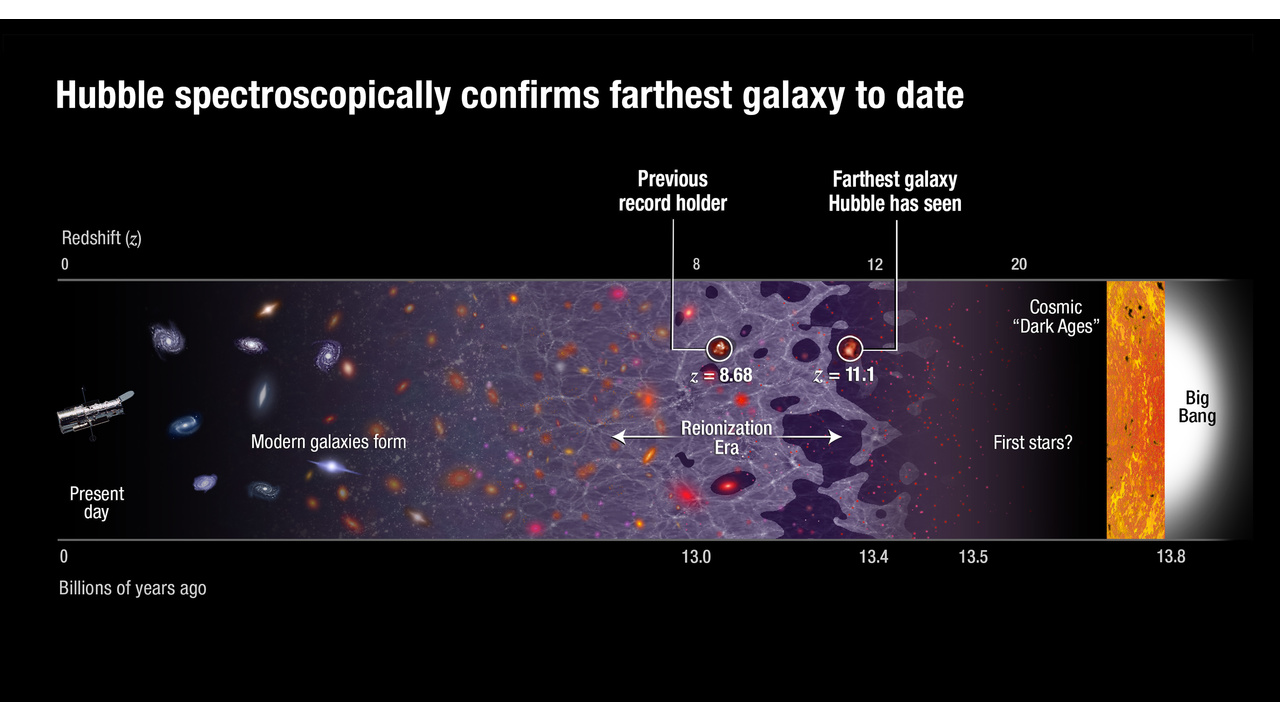
The Hubble Space Telescope has detected near-infrared light from a galaxy shining about 400 million years after the Big Bang. The figure above relates the measured redshift to the lookback time. This galaxy has a redshift of 11.1 and the James Webb Space Telescope is now routinely finding galaxies with redshifts greater than 14 (such as JADES-GS-z14-0 and MoM-z14). Webb has been able to closely analyze galaxies in the Reionization Era to see how the young galaxies clear away the gas. Webb observations prove that the galaxies' massive stars were able to provide the ultraviolet light needed to heat and ionize the gas around them and the transparent bubbles around the galaxies had grown to about two million light years (most galaxies back then were only a few thousand light years in size). Hubble was able to find a galaxy near the end of the Reionization Era (called “MXzDFz4.4”) that shows how the ionizing light was able to move beyond the galaxy bounds. Tightly clustered massive stars forming at rates many times greater than what happens in galaxies today produced the ionizing light and their supernovae explosions at the ends of their lives enable even more of the ionizing light to escape the galaxy to the surrounding hydrogen gas. In some cases, the light from very distant galaxies is magnified by gravitational lensing as the light passes through foreground galaxy clusters. The smaller predecessor of Webb, the Spitzer Space Telescope, was able to study a galaxy from only 950 million years after the Big Bang because the lensing makes the distant galaxy 11 times brighter—otherwise the galaxy would have been undetectable by Spitzer. The observations showed that the galaxy's stars must have formed when the universe was only 200 million years old. As Webb and Hubble continue to push the boundaries on the most distant galaxies, we are finding that the young galaxies were much more energetic and able to form stars more quickly than the nearby galaxies of the present day and galaxies were able grow to substantial size much more quickly than we originally thought possible. A lot of research is now trying to figure out how the galaxies could do this.
The figure below shows another connection between the nearby galaxies and the Cosmic Microwave Background Radiation. It compares the galaxy/quasar slice maps from the SDSS surveys to the Dark Ages and the microwave background. The 2008 SDSS slice map shown in the Superclusters section of the Galaxies chapter has a lookback time less than half as far as the final 2017 galaxy map (yellow dots) at the far left which extends out to a lookback time of 5 billion years.

The galaxy seeds density fluctuations in the early hot universe before recombination (before the time of the microwave background) produced sound waves in the hot plasma as the subatomic particles oscillated between being pulled together by gravity and bouncing off each other because of the extreme temperatures (outward gas pressure). The trapped photons moved with the gas as a single fluid. These circular patterns of sound wave ripples are called baryon acoustic oscillations (BAO) (from the physics term for the protons and neutrons that provide most of the mass of ordinary matter: “baryons” and “acoustic”, a physics term for waves, vibrations, and sound). The speed, wavelength, and amplitude of sound waves depends on the density and temperature of the medium they pass through. (See Daniel Eisenstein's “Acoustic Peak” webpage for a more detailed description of the pressure waves in plasma fluid of the early universe.) At recombination, the photons were no longer trapped and sound waves stopped expanding, “freezing” them into place. At that time the BAO bubbles were about 900,000 light years across and can be seen in the microwave background radiation. Over time the BAO bubbles of slightly greater density would have grown with the expansion of the universe to about 980 million light years across today. More importantly, those bubbles would have only grown due to the expansion of the universe, so the size of the BAO bubbles could be used as a cosmic ruler or “standard ruler” to determine distances based on the angular size of the bubbles.
The huge galaxy surveys discussed in the Galaxies chapter have mapped the locations of many hundreds of thousands to millions of galaxies and quasars—enough to detect the signal of the slight tendency for more galaxies to be found in the overdensities of the BAO bubbles. These surveys have also used the quasar light filtering through the intergalactic hydrogen gas to find the BAO bubbles in the hydrogen gas. With millions of galaxies measured, the Dark Energy Survey (DES) has used the BAO bubble sizes at different redshifts to measure how the expansion rate (the Hubble Constant) changes with time to lookback times of about 7 billion years to a precision of 2% uncertainty. The eBOSS project of the Sloan Digital Sky Survey measured the BAO bubbles back to greater lookback times but greater uncertainties (see also this explanation of the DES and eBOSS results).
 Go back to previous section --
 Go to next section
last updated: July 12, 2026