This material (including images) is copyrighted!. See my copyright notice for fair use practices.
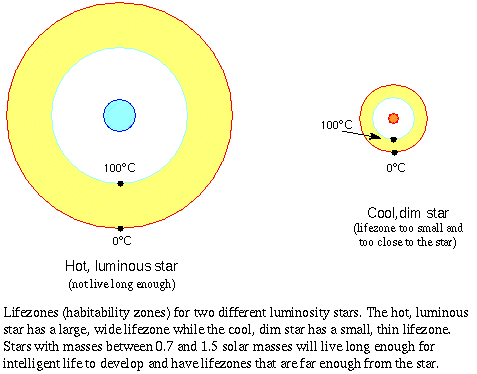
For reasons explained in the habitable planets and bio-markers sections below, our search for inhabited exoplanets is focusing on those that have water-based life existing on the surface of the exoplanet. The habitable zone, or life zone, is the distance from the star where the temperature on the surface is between the freezing point (0° C) and boiling point (100° C) of water. If you consider a planet with the same reflectivity (clouds and surface material) as the Earth, reradiates the solar energy it absorbed as efficiently as the Earth does, and rotates as quickly as the Earth does, then the habitable zone for the Sun (a G2 main sequence star) is between approximately 0.63 and 1.15 A.U. Calculations that include the effects of the greenhouse effect and whether or not there is a runaway process and ultraviolet dissociation of water like what happened on Venus shift the Sun's habitable zone outward so that the Earth is nearer the inside edge of the habitable zone. Climate research is still at the beginning stages of development, so the habitable zone boundaries are a bit uncertain. Note that the discussion in this section ignores the effect of internal heating that could create liquid water places at much greater distances from the star (e.g., tidal heating of a jovian planet's moon).
The habitable zone of a hotter main sequence star will be farther out and wider because of the hotter star's greater luminosity. Using the same line of reasoning, the habitable zone of a cooler main sequence star will be closer to the star and narrower. You can use the inverse square law of light brightness to determine the extent of the habitable zones for different luminosity stars. The boundary distance is
For example, if the Sun's habitable zone boundaries are 0.9 and 1.5 A.U, the inner and outer bounds of the habitable zone for a star like Vega, an A0-type main sequence star with (Vega luminosity/Sun luminosity = 53) are 6.6 to 10.9 A.U., respectively. For a cool star like Kapteyn's Star, a M0 main sequence star with (Kapteyn's star luminosity/Sun luminosity = 0.004), the habitable zone stretches from only 0.056 to 0.095 A.U.
One of the first exoplanets discovered that orbits in its star's habitable zone is "Gliese 581c". Gliese 581c orbits in the habitable zone of an M3-type star, Gliese 581, about 20.4 light years from us. Gliese 581 has a luminosity = 0.013 solar luminosities (even though it is a cooler spectral type than Kapteyn's star). That would put the habitable zone of Gliese 581 between 0.1 AU and 0.17 AU. What is even more intriguing is that Gliese 581c has a mass of just five times the Earth (though that is a minimum derived mass), so it should have a solid surface that liquid water could collect upon as well as enough gravity to hold onto an atmosphere. This planet and the another slightly more massive planet (at a minimum of 8 Earth masses) orbiting Gliese 581 will certainly be studied a lot over the coming years! A major problem with the planet's habitability is its very close distance to the star as described in the next section. Since its discovery, many other exoplanets have been discovered in the habitable zones of their planetary systems, especially by the Kepler mission as described in exoplanet section elsewhere on this website.
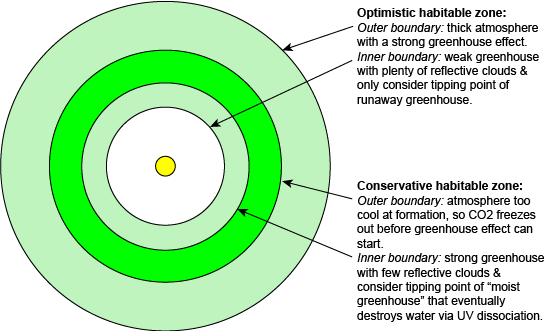
The much-heralded conclusion that 1 in 5 sun-like stars have an Earth-sized planet (1 to 2 Earth diameters in size) orbiting in their habitable zone is for stars of spectral type G and K and uses an optimistic estimate of the habitable zone boundaries where the inner boundary is the planet receiving up to four times the flux of energy from its star than the Earth receives from the Sun and the outer boundary is the planet receiving as little as 0.25 times (one-fourth) the flux of energy from its star than the Earth receives from the Sun. For a star like the Sun, that corresponds to 0.5 to 2 A.U. Both Venus and Mars would fit within that definition of the habitable zone. More conservative (pessimistic) estimates of the habitable zone that narrow the region drop the fraction of sun-like stars with an Earth-sized planet in the habitable zone down to 6 to 9%. Even with this smaller fraction, though, the potential Earth-analogues in our galaxy alone would number in the hundreds of millions for just the sun-like stars. As explained in the next section, it is possible that suitable stars with habitable planets orbiting them could be much more than just the sun-like stars.
First consider the lifetime of a star. Let's assume that it takes 3 billion years for intelligence to evolve on a planet (note, though, that Earth took about 4.5 billion years). The star must last at least 3 billion years! Use lifetime = (mass/luminosity) × 10 billion years = 1/M3 × 10 billion years if the star's mass is in units of solar masses. The most massive star's (1.4 solar masses) lifetime = 3.6 billion years (a 1.5-solar mass star with a lifetime = 3.0 billion years would just barely work too).
The less massive stars have longer lifetimes but the habitable zones get narrower and closer to the star as you consider less and less massive stars. At the outer boundary of the habitable zone the temperature is 0° C for all of the stars and the inner boundary is at 100° C for all of the stars. You can use the observed mass-luminosity relation L = M4 in the habitable zone boundary relation given above to put everything in terms of just the mass. Substituting M4 for the luminosity L, the 1.4-solar mass star's habitable zone is between 1.76 A.U. and 2.94 A.U. from the star (plenty wide enough). The 0.5-solar mass star's habitable zone is only 0.23 A.U. to 0.38 A.U. from the star. Planets too close to the star will get their rotations tidally locked so one side of planet always faces the star (this is what has happened to the Moon's spin as it orbits the Earth, for example). On such a planet the night side temperature could drop so much that the atmosphere froze out. This actually happens for 0.7-solar mass stars, but if the planet has a massive moon close by, then the tidal locking will happen between the planet and moon. This lowers the least massive star limit to around 0.5 solar masses. The "super-Earths" of Gliese 581 would be tidally-locked to their star (Gliese 581 has a mass of only 0.31 solar masses).
On the other hand, if the planet has a thick carbon-dioxide atmosphere, the atmosphere could circulate enough heat between the day and night sides to keep the surface temperatures uniform (like Venus). Most small, cool M stars have frequent stellar flares with more energy than our Sun's flares that could kill off any complex life. Perhaps a planet with thick enough atmosphere to keep the surface temperatures uniform could also provide enough of a shield from the flares. Also, a planet larger than Earth might be able to generate a strong enough magnetic shield to protect the atmosphere. The very narrow habitable zone of the small, cool stars would mean a small chance of finding a nice planet in the habitable zone. On the other hand, the sheer number of M stars in the Galaxy (recall that the M stars make up the greatest proportion of stars) means that there could be many habitable worlds around M stars. Based on the census of stars by the Kepler mission, about 50% or so of the M stars have a planet between 0.5 to 1.4 Earth diameters orbiting within their habitable zone. That statistic means that the closest Earth-size exoplanet having its orbit aligned just right with our line of sight so the exoplanet transits its star is just 29 light years away. See the Kepler mission's "In the Zone" page for a summary of these factors in determining habitability of a given exoplanet.
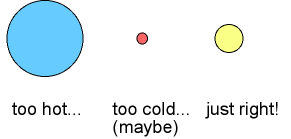
Any life forms will need to use some of the elements heavier than helium (e.g., carbon, nitrogen, oxygen, phosphorus, sulfur, chromium, iron, and nickel) for biochemical reactions. This means that the gas cloud which forms the star and its planets will have to be enriched with these heavy elements (called "metals" by astronomers as a catch-all term) from previous generations of stars. If the star has a metal-rich spectrum, then any planets forming around it will be enriched as well. This narrows the stars to the ones of Population I---in the disk of the Galaxy. Now that the Kepler mission has built up enough planet detections, researchers have been able to separate out enough stars with small planets from those with larger jovian planets to have decent statistics from which to draw valid conclusions. They find that smaller planets can form around stars with metallicities as low as just a quarter that of the Sun while the jovian planets require more metal-enriched environments. This result means that small terrestrial-sized planets could be more common in the galaxy (and the rest of the universe) than previously thought. Most searches are focusing on the stars more like the Sun that are not too hot nor too cool---those with masses between 0.5 and 1.4 solar masses. Some searches are including the M stars but they will need to look at a large number of M stars to improve their chances of finding the ones with habitable planets.
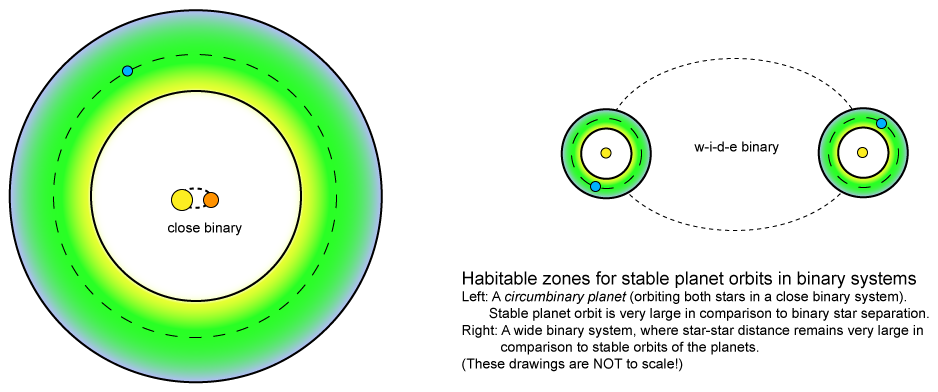
Most stars in the Galaxy have at least one stellar companion---binary or multiple star systems. Stars like our Sun with no stellar companion are in the minority. It would probably be difficult for there to be stable, only slightly elliptical planet orbits in a binary or multiple star system. Complex life (multi-cellular) will need to have a stable temperature regime to form so the planet orbit cannot be too eccentric. Simple life like bacteria might be able to withstand large temperature changes on a planet with a significantly elliptical orbit but complex life is the much more interesting case. Suitable binary stars would be those systems where either the binary stars orbit very close to each other with the planet(s) orbiting both of them at a large distance (called a "circumbinary planet") or the binary stars orbit very far from each other so the planet(s) could reside in stable orbits near each of the stars---the one star's gravity acting on a planet would be much stronger than that of the other star.
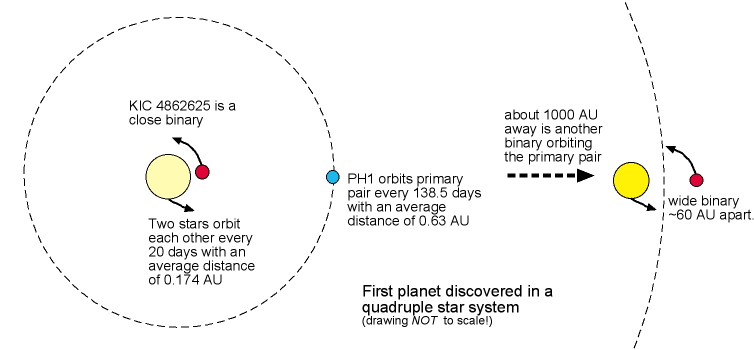
The first discovery of a binary star system with a planet is the first case (orbiting both of them—circumbinary planet): the Kepler-16 stars are a K-type star with 69% the mass of the Sun and a M-type star with 20% the mass of the Sun orbiting each other every 41 days and the planet, Kepler-16b, about the mass of Saturn, orbits them both every 229 days, well outside the habitable zone of the combined stars. The planet was discovered using the transit technique (select the link to find out about that planet detection technique). Since Kepler-16's discovery in 2011, several other circumbinary planets have been discovered, so we now know that Kepler-16 is not an unusual or rare case. Kepler 47 is a circumbinary planet system announced in August 2012 that has at least three planets, one of which is in the habitable zone. In October 2012, a circumbinary planet in a quadruple star system was announced. The planet named PH1 is slightly larger than Neptune and has less than half a Jupiter mass. It orbits the two inner stars every 138.5 days and well outside PH1's orbit is a binary star system that orbits the first binary (primary pair) at about 1000 AU. The habitable zone of the primary pair is outside the orbit of PH1. Might there be other planets in this system?
Also in October 2012 was the announcement of a planet in the Alpha Centauri trinary system, the closest star system to us. Using the doppler shift technique, the research team claimed they found a planet with a minimum mass of just 1.13 times the Earth orbiting Alpha Centauri B at only 6 million kilometers with a period of 3.24 days. The size of the doppler wobble at just 0.51 meter per second (or about the speed of a baby crawling) was at the limit of detection by the doppler shift technique, so verification of the claim by independent research teams were definitely required as is standard for the science process. Three years later a different research team found that the faint signal of the planet was actually a statistical artifact of how the original data was processed and analyzed. No planet.
In August 2016 a more promising claim was made of an exoplanet orbiting Proxima Centauri, the third star of the Alpha Centauri system. At 1.38 meters per second, Proxima Centauri's wobble is almost three times the size of the one claimed for Alpha Centauri B in 2012. The brighter two stars, Alpha Centauri A and B are a spectroscopic binary---orbiting close enough to each other that to the naked eye, they appear as one object with a combined brightness that makes them the third brightest star in the sky after Sirius and Canopus. Alpha Centauri A is a G2-type star, slightly hotter than the Sun and Alpha Centauri B is a K1-type star, slightly cooler than the Sun. Alpha Cen A and B orbit each other in an elliptical orbit that brings them as close as 11.2 AU and as far as 35.6 AU. The third star of the system, Proxima Centauri is a small red dwarf M6-type star that orbits very far from the central pair at a distance of about 15,000 AU.
Proxima Centauri's planet has a minimum mass of about 1.3 Earth masses and orbits the star at just 0.05 AU in 11.2 days. That close distance is within Proxima Centauri's habitable zone! Although the star is a moderately active star, during the quiet periods, its activity and X-ray output are comparable to those of the Sun. The "habitability of Proxima Centauri b" website discusses the habitability of the exoplanet under two possible rotation scenarios: a synchronous one (rotation period equals orbit period) and a 3:2 spin-orbit resonance (3 spins for every 2 orbits like Mercury has). The research team's two papers about the habitability of Proxima Centauri b are published in the Astronomy & Astrophysics journal. The discovery has certainly made a number of science fiction fans (including those who are also astronomers!) very excited since the Alpha Centauri system has been the subject of numerous stories. Stay tuned!
Finally, what about all of the possible "free floater" planets—those that probably formed around a star but were later ejected through gravitational interactions with other planets in the system? There may be more free floaters than there are normal stars in the Galaxy according to a recent estimate. It is possible that the free floater planets could harbor life but such planets would be too hard to investigate because they are too dim and small. Such planets are found only when by chance they pass nearly in front of some distant star and they distort the light of the distant star in a microlensing effect. The technique allows us to find the mass of the free floater planets but not much else. Therefore, we will focus our attention on the planets orbiting stars because those planets can be repeatedly observed over an extended length of time and probed with various analytical techniques.
 Go back to previous section --
 Go to next section
last updated: July 1, 2022