Video lecture for this chapter
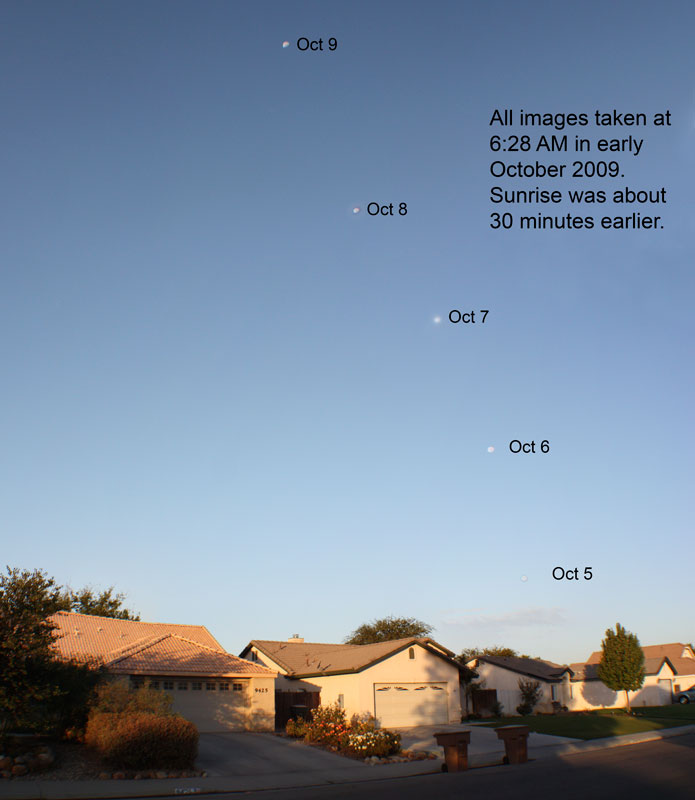
The moon moves rapidly with respect to the background stars. It moves about 13 degrees (26 times its apparent diameter) in 24 hours---slightly greater than its own diameter in one hour! The image below illustrates this rapid motion as well as the fact that you can see the Moon during the day. (Select the image to bring up an enlarged version.) Closer inspection of the image shows that the first image is a waning gibbous phase one day past full phase and the sequence progresses toward less of the visible part of the Moon being visible as the Moon moves closer to the Sun as seen from the Earth. Among other things, this section will explain why these images had to taken in the early morning and why I had to be facing toward the west-southwestern direction with the Sun more or less behind me.
Its rapid motion has given it a unique role in the history of astronomy. For thousands of years it has been used as the basis of calendars. Isaac Newton got crucial information from the Moon's motion around the Earth for his law of gravity.
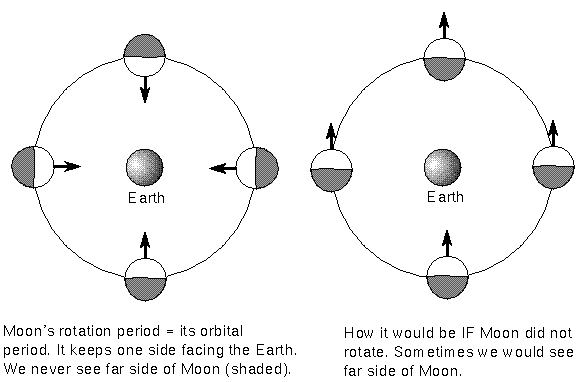
If you watch the Moon throughout the year, you will see the same face of the Moon all of the time. It is the ``man in the moon'', ``woman in the moon'', ``rabbit in the moon'' etc. One thing this shows you is that the Moon turns exactly once on its axis each time that it goes around the Earth. Later on you will find out how tidal forces have caused this face-to-face dance of the Earth and Moon. The Moon drifts eastward with respect to the background stars (or it lags behind the stars). It returns to the same position with respect to the background stars every 27.323 days. This is its sidereal period.
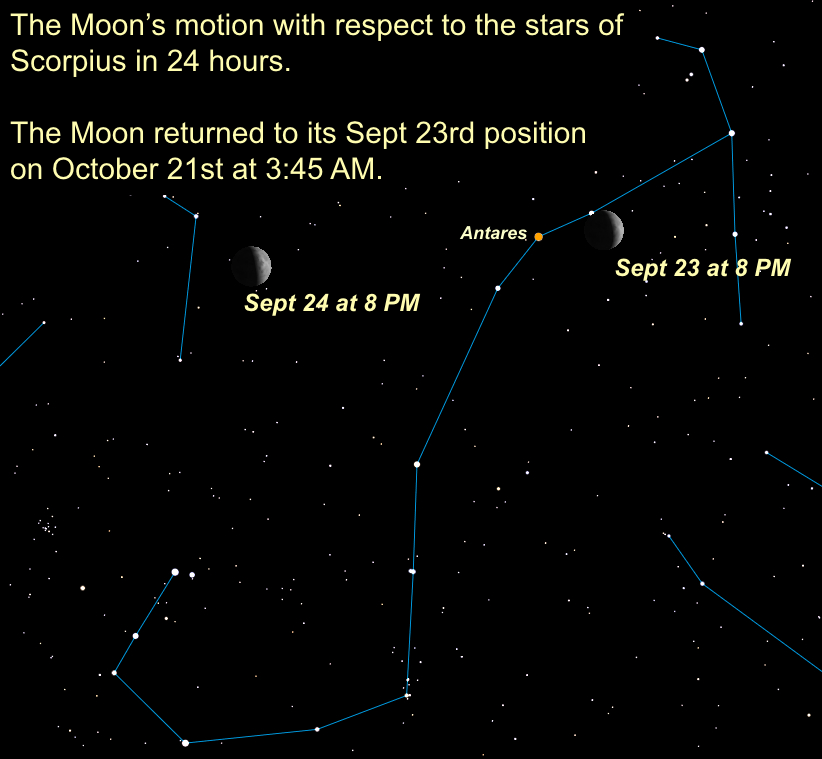
Select the image for a larger version
 Go back to previous section --
 Go to next section
last updated: January 18, 2022