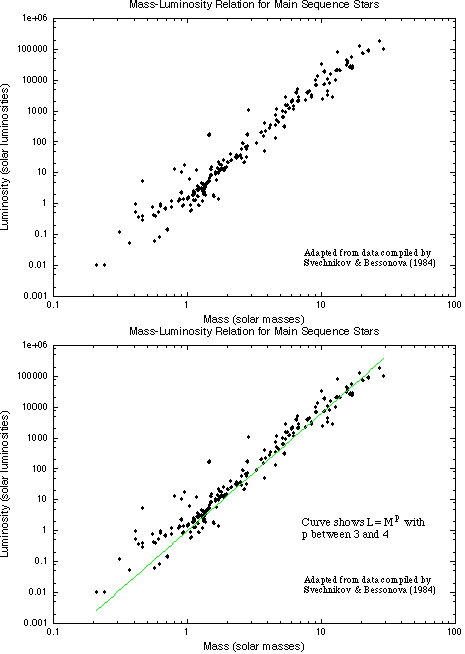
The mass-luminosity relation for 192 stars in double-lined spectroscopic binary systems.
The mass-luminosity relation for 192 stars in double-lined spectroscopic
binary systems.
Observations of thousands of main sequence stars show that there is definite relationship between their mass and their luminosity. The more massive main sequence stars are hotter and more luminous than the low-mass main sequence stars. Furthermore, the luminosity depends on the mass raised to a power that is between three and four (Luminosity ~ Massp, where p is between 3 & 4). This means that even a slight difference in the mass among stars produces a large difference in their luminosities. For example, an O-type star can be only 20 times more massive than the Sun, but have a luminosity about 10,000 times as much as the Sun. Putting together the principle of hydrostatic equilibrium and the sensitivity of nuclear reaction rates to temperature, you can easily explain why.
Massive stars have greater gravitational compression in their cores because of the larger weight of the overlying layers than that found in low-mass stars. The massive stars need greater thermal and radiation pressure pushing outward to balance the greater gravitational compression. The greater thermal pressure is provided by the higher temperatures in the massive star's core than those found in low-mass stars. Massive stars need higher core temperatures to be stable!
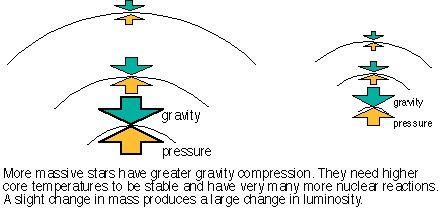
The nuclear reaction rate is very sensitive to temperature so that even a slight increase in temperature makes the nuclear reactions occur at a MUCH higher rate. This means that a star's luminosity increases a lot if the temperature is higher. This also means that a slight increase in the mass of the star produces a large increase in the star's luminosity.
The principle of hydrostatic equilibrium and nuclear fusion theory also explain why stars have a certain range of masses. The stars have masses between 0.08 and about 100 solar masses.
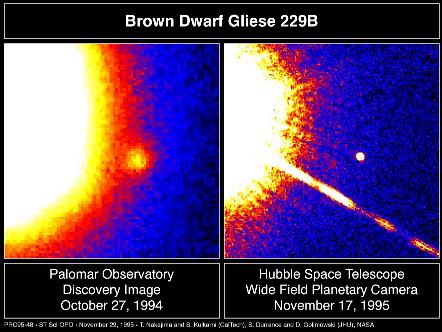
Stars with too little mass do not have enough gravitational compression in their cores to produce the required high temperatures and densities needed for fusion of ordinary hydrogen. The lowest mass is about 0.08 solar masses or about 80 Jupiter masses. A star less massive than this does not undergo fusion of ordinary hydrogen but if it is more massive than about 13 Jupiters it can fuse the heavier isotope of hydrogen, deuterium, in the first part of its life. Stars in this boundary zone between ordinary stars and gas planets are called brown dwarfs. After whatever deuterium fusion it does while it is young, a brown dwarf then just slowly radiates away the heat from that fusion and that is left over from its formation. Among the first brown dwarfs discovered is the companion orbiting the star Gliese 229. Selecting the picture below of Gliese 229 and its companion, Gliese 229B, will take you to the caption for the picture at the Space Telescope Institute.
With the discovery of several hundred brown dwarfs in recent infrared surveys, astronomers have now extended the spectral type sequence to include these non-planets. Just beyond the M-stars are the L dwarfs with surface temperatures of about 1400 K to 2200 K with strong absorption lines of metal hydrides and alkali metals. Cooler than the L dwarfs are the T dwarfs. At their cooler temperatures, methane lines become prominent.
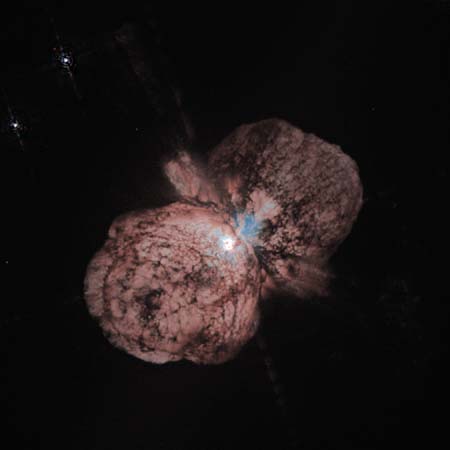
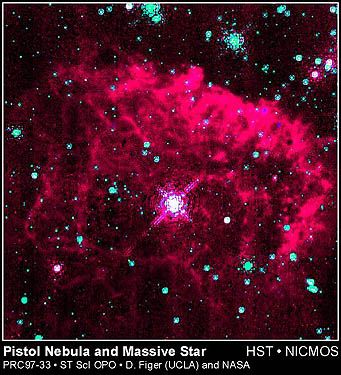
Stars with too much mass have so much radiation pressure inside pushing outward on the upper layers, that the star is unstable. It blows off the excess mass. The limit is roughly about 100 to perhaps 150 solar masses. Stars like Eta Carinae and the “Pistol star” are examples of these supermassive stars. The picture of Eta Carinae below shows two dumbbell-shaped lobes of ejected material from the star in an earlier episode of mass ejection. Selecting the image will take you to more information about the image (will display in another window).
The picture below from the Hubble Space Telescope shows the violet Pistol Star surrounded by hydrogen gas fluorescing from the copious ultraviolet light coming from the star. Selecting the image will bring up the press release in another window.
 Go back to previous section --
 Go to next section
last updated: June 14, 2026