This material (including images) is copyrighted!. See my copyright notice for fair use practices.
Several thousand planets have been found orbiting other stars—exoplanets (sometimes also called extrasolar planets)—in a few thousand exoplanet systems (about a thousand are multi-planet systems) as of June 2026. New discoveries are always being made, so check out the links in the previous sentence or the NASA Discoveries Dashboard for the latest census. This section will first look at how we find exoplanets and then I will draw some preliminary conclusions based on the statistics of the orbits and masses of the exoplanets.
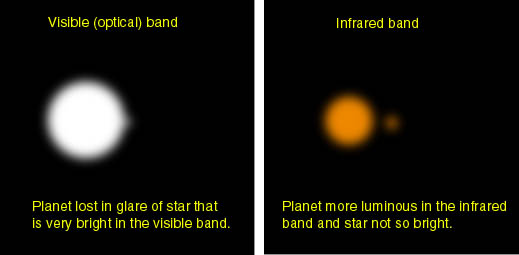
Detecting exoplanets around other stars is a difficult project requiring very careful observations. At first finding exoplanets might seem a simple thing to do—take pictures of stars and look for small faint things orbiting them. An exoplanet would indeed be a faint: a billion or more times fainter than a star in the visible band—the glare of the starlight would wash out the feeble light of an exoplanet. The direct imaging technique of finding exoplanets would be better accomplished in the infrared band because the exoplanet's thermal spectrum would have maximum emission in the infrared band. Also, stars produce less infrared energy than visible band energy—an exoplanet would only be ten thousand to a hundred thousand times fainter than the star. The exoplanet would still be very faint, but at least the contrast ratio is improved by many thousands of times. The direct imaging technique is able to find Jovian exoplanets far from their parent stars. Less than 2% of exoplanets have been found this way.
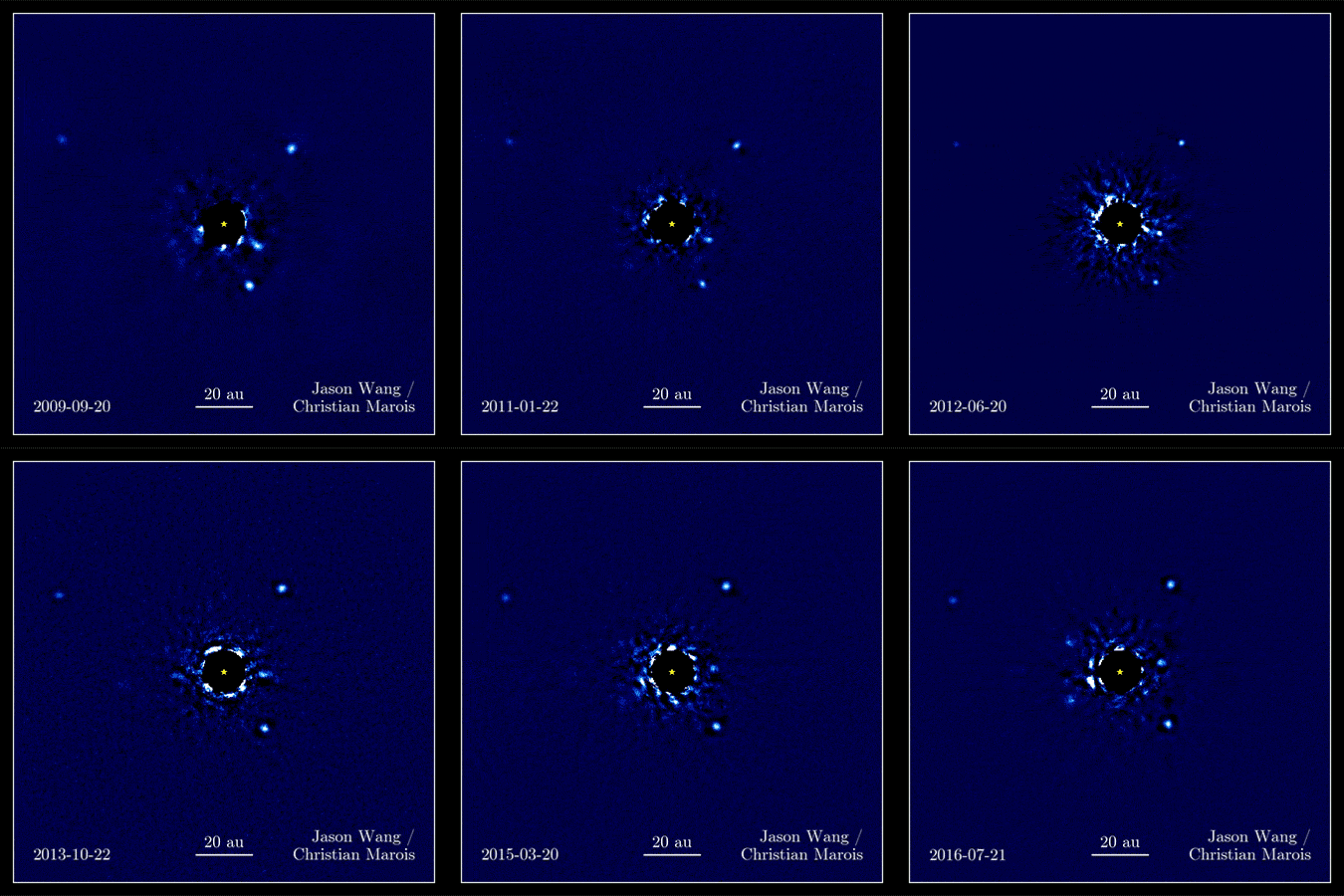
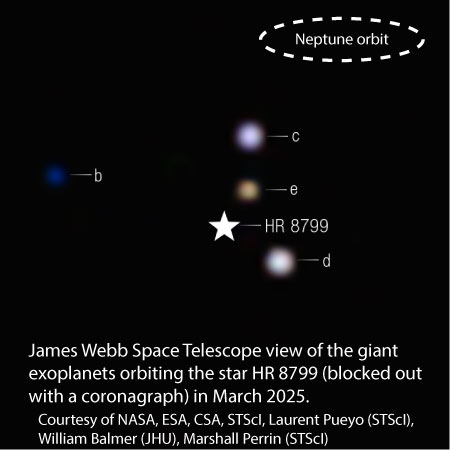
Some of the exoplanets imaged are very young and still quite warm from their formation. Therefore, the young exoplanets are quite bright in the infrared and easier to detect. Some exoplanets have been imaged by blocking the light from the much brighter star with a device called a coronagraph so that the feeble light from the exoplanet can be detected. One nice example is shown below: HR 8799 imaged in infrared with the Keck Observatory over seven years (2009 to 2016) on the left and then by the James Webb Space Telescope on the right in 2025. An oblique view of Neptune's orbit is shown for scale in the top right corner.
 --
-- 
Astronomers have detected disks of dust and gas around young stars using sensitive infrared detectors on the largest telescopes in the world. An equivalent amount of material locked up into a single object will have a smaller total surface area than if it was broken up into many tiny particles. The disks have a lot of surface area and, therefore, can emit a lot of infrared energy. Some bright stars in our sky have dust around them: Vega, Beta Pictoris, and Fomalhaut. These are systems possibly in the beginning stages of forming planets. One disk around the star HR 4796A appears to be in between the dust disk stage and a fully-fledged planet system. The inner part of the disk has been cleared away. Presumably, the dust material has now coalesced into larger things like planets. The exoplanets would have a smaller surface area than if the material was still in tiny particles form, so the exoplanets will be much fainter. One heralded discovery with the Hubble Space Telescope that turned out to be a “false positive” was the visible light detection of a large planet orbiting Fomalhaut. Images taken over 8 years (2004 to 2012) seemed to show a planet orbiting 115 AU from Fomalhaut. However, the bright spot was much too dim in the infrared to be an exoplanet and the moving spot has now faded away. What we may have seen was the expanding dust cloud from the collision of two large asteroids. If this explanation is correct, then we were very lucky to have spotted it within a couple of months of the collision. The Hubble Space Telescope has also detected disks of gas and dust around 50% of the stars still forming in the Orion Nebula. It appears that the formation of planet systems is a common process in the universe.
Another way to look for exoplanets is to notice their gravitational effect on the stars they orbit. We observe the star, not the exoplanet, and infer the existence of the exoplanet from how it yanks on the star. One signature of an exoplanet would be that the star would appear to wobble about as the star and the exoplanet orbit a point situated between them, proportionally closer to the more massive star, called the center of mass. This technique is called the astrometric technique. Recall from the gravity chapter that the gravity force acting on the star and the exoplanet must be the same but the much smaller mass exoplanet will have much greater acceleration and the massive star will have a much smaller acceleration—just a “wobble”.
Our Sun wobbles because of the gravity of the planets orbiting it. Most of the wobble is due to Jupiter which contains more mass than all of the other planets combined. However, the wobble is tiny! Because the Sun is over a thousand times more massive than Jupiter, the center of mass is over a thousand times closer to the Sun, or about 47,000 kilometers above the surface of the Sun (this distance is less than 7% the radius of the Sun). Despite the tiny wobble, astronomers on planets orbiting nearby stars could detect this wobble using the same technology we have here on Earth if they observed the Sun's motion very carefully over a couple of decades. The stronger the gravity between the star and exoplanet, the larger will be the wobble of the star and the easier to detect. Therefore, the astrometric technique is well-suited to finding massive Jovian exoplanets close to their parent stars. Not only is the wobble larger but it is also happens more quickly, so one can see the periodic motion in a short amount of time. Because of the distorting effect of the Earth's atmosphere, only two exoplanets has been found using this technique using ground-based telescopes (at the time of writing). The now-canceled SIM Lite mission was to use this technique and the Gaia mission, which operated from December 2013 to January 2025, found four using this technique. Many more will eventually be found in the Gaia data as astronomers continue to mine its vast database.
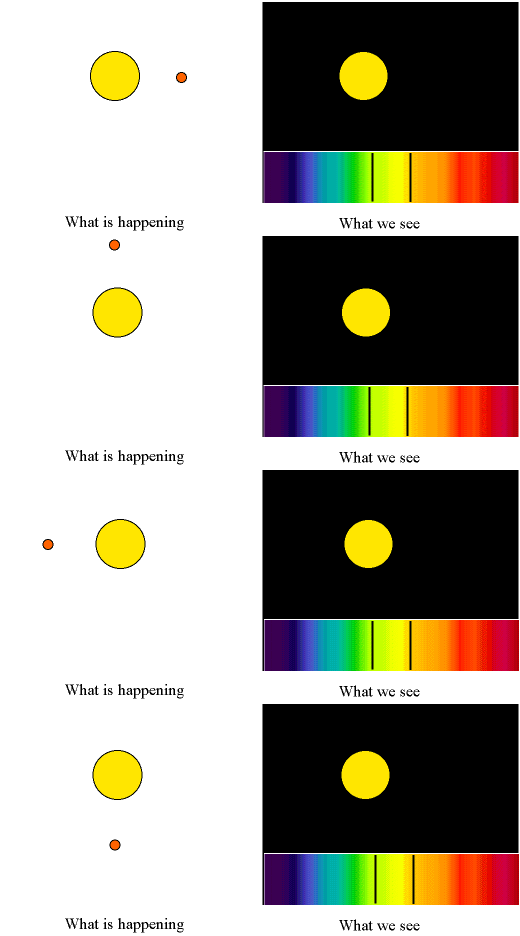
Another signature of an exoplanet would be doppler shifts in the star's spectral lines as they orbit their common center of mass. The doppler shift technique (also sometimes called the radial velocity technique) has been the easiest way to find exoplanets so far from the ground. Almost 19% of the detected exoplanets have been found using the doppler shift technique. Like the astrometric technique, the doppler shift technique is well-suited to finding massive Jovian exoplanets close to their parent stars. However, in 2016 astronomers were able to refine the technique enough to detect an exoplanet around Proxima Centauri (the closest of the three stars in the nearest star system to us) with 1.3 times the mass of Earth from a doppler star wobble they measured of just 1.38 meters per second or about the speed of a person walking. Proxima Centauri b orbits within Proxima Centauri's habitable zone. The habitable zone is the region around a star in which an exoplanet's surface would be not too hot nor too cold for liquid water to exist on the surface. Improvements in technology enabled astronomers in 2025 to refine the star wobble measurement to 1.23 meters per second for Proxima Centauri b's effect on the star, reducing the exoplanet's mass to 1.06 times the mass of Earth and to find an even less massive exoplanet (Proxima Centauri d at just 0.26 Earth masses) orbiting closer to Proxima Centauri. Proxima Centauri d creates a wobble of just 0.39 meters per second!
In another milestone of the technique, astronomers announced in late June 2013 after several years of radial velocity measurements of a nearby star Gliese 667C (just 22 light years away), the discovery of three exoplanets orbiting in the habitable zone of the star. While other exoplanets have been found in the habitable zones of stars, especially by the Kepler mission discussed below, this was the largest number of exoplanets in a habitable zone up to that time (TRAPPIST-1 took the title in 2016), and for Gliese 667C, very likely the largest number of exoplanets possible in its habitable zone (so the habitable zone is said to be “dynamically packed”). In our solar system there is just one habitable planet, Earth. Mars might have been habitable if it was bigger to retain a thicker atmosphere and have plate tectonics working on it for long-term habitability. Gliese 667C is a low-mass star, smaller than our Sun and those cooler, lower mass stars are more common in the Galaxy than stars like the Sun. Gliese 667C has two other exoplanets orbiting it: one much closer in and another much farther away.
The period of the star wobble is measured and then the distance (semi-major axis of the orbit) is derived from Kepler's third law. The star's velocity change is measured and then the total mass of the system is derived from Newton's Laws of Motion. We can estimate the mass of the star from its spectral type, estimate the exoplanet velocity from the star wobble period and then derive the exoplanet's mass. However, the doppler effect tells you about the motion along the line of sight only. The exoplanet orbits are undoubtedly inclined, or tipped, to our line of sight and the amount of inclination is uncertain. This introduces an uncertainty in the derived masses of the exoplanets. Usually, astronomers will quote the masses as “mass×sin(orbit inclination angle)”, so the actual exoplanet masses could be higher. The star-wobble techniques can also give us the orbit eccentricity if we have observations from the entire orbit. The three exoplanets in the habitable zone of Gliese 667C have minimum masses (“M sin(i)”) of 2.7 to 3.8 times the mass of the Earth, so they are called “super-Earths”. Because of the uncertainty in inclination of their orbits, their masses may be up to two times larger based on computer models of what gravitationally stable planet orbits would be possible.
In the context of exoplanet research, a “super-Earth” is usually defined by mass only: a world between about 1.9 to ten times the mass of Earth (the lower bound value of 1.9 Earth masses is not universally agreed upon, so you will find a variety of mass and diameter ranges in the research papers). The term does not necessarily mean the planet is habitable. The upper limit of ten times the mass of Earth is used because it is thought that planets larger than 10 times the mass of Earth will have enough gravity to suck up the hydrogen and helium surrounding it as it is forming and become a Jovian planet. The NASA Kepler spacecraft mission defined super-Earth by diameter instead of mass because it used the transit method (defined below) to find exoplanets. For Kepler, a super-Earth is any exoplanet between 1.25 and 2 Earth diameters. If the super-Earth has a density the same as Earth, then that corresponds to a mass range of 1.95 to 8 Earth masses. However, the discovery of Kepler 10c announced in June 2014 with a mass of 17.2 times the Earth but just 2.35 times the diameter of the Earth means it has a density = 7.1 times water, so it is definitely a rocky world instead of something like Neptune or Jupiter. (Nature doesn't always fit into our nice, neat boxes.)
A research group headed by Benjamin Fulton might have found the dividing line between super-Earths and mini-Neptunes. In this refinement of “super-Earth”, a super-Earth is a planet that is primarily a rock-iron world while a mini-Neptune planet has a much greater proportion of lighter hydrogen compounds—water, ammonia, methane—and hydrogen and helium. If the exoplanet is less than about 1.75 times the diameter of Earth, it is a super-Earth. If it is above two times the diameter of Earth, the forming exoplanet has enough mass to pull in enough hydrogen and helium from its surrounding environment nebulae to become something like Neptune. Fulton's group has sharply defined the upper size for a habitable world. Worlds larger than two times the size of Earth will either have no surface or the surface is under an extremely deep atmosphere with such a crushingly high pressure (far more than that found at the deepest point of the Marianas Trench on Earth) that no life we know of could exist.
Astronomers cannot yet determine both the diameters and masses of most of the exoplanets, so their densities, and, therefore, their composition is still unknown. Before the Kepler mission, only a small fraction of the exoplanets had been observed to move in front of their stars and cause an eclipse or dimming of the starlight from ground-based telescopes. This is called a transit so this means of detecting exoplanets is called the transit technique. A transit means that the exoplanet's orbit is aligned with our line of sight (and the inclination angle is nearly 90 degrees). From the exoplanet transit, astronomers have been able to accurately measure the diameter of the exoplanet. Using the exoplanet mass from the star wobble methods, you can then determine the density.
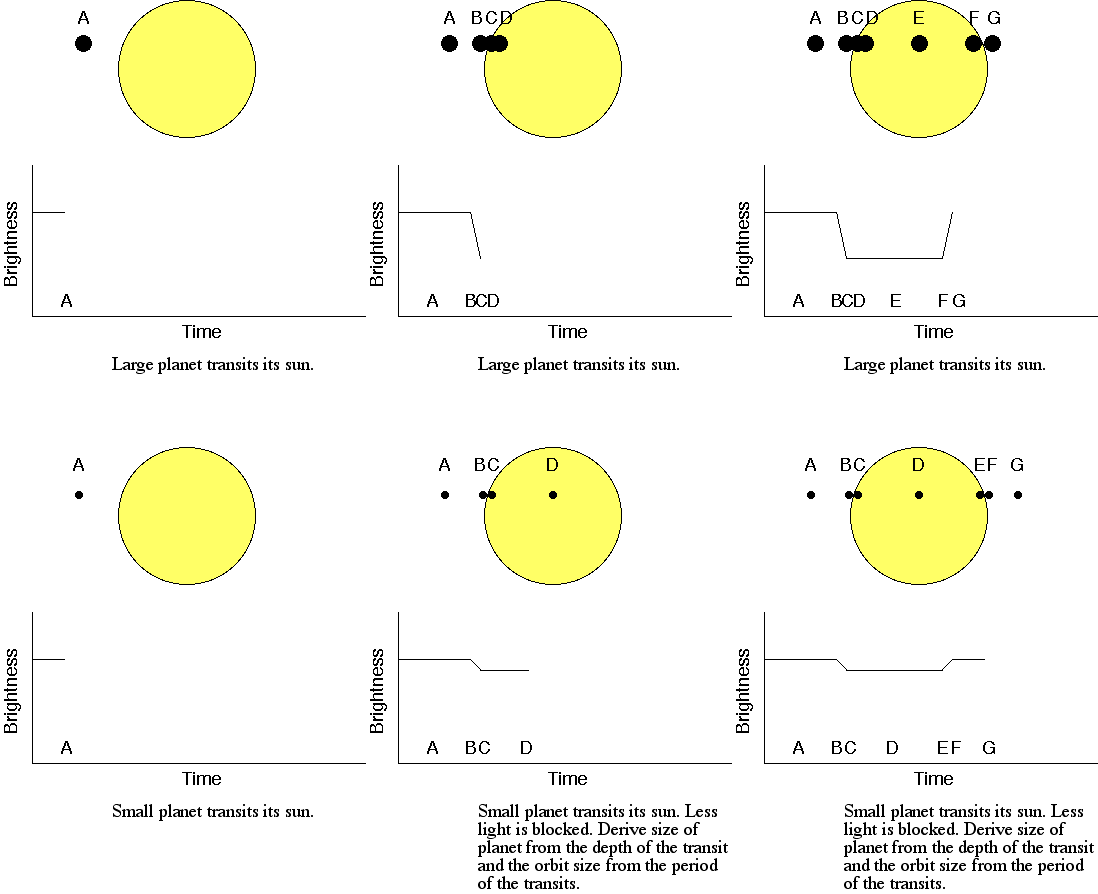
Most of the transiting exoplanets discovered in the early years were first detected via the doppler shift technique, but with the exquisite instrumentation on the Kepler spacecraft and its location in space above the distorting atmosphere, the transit technique became a very prolific way of searching for exoplanets around other stars. By the end of the mission in October 2018, Kepler had found 2687 exoplanets with another 2898 candidates still to be confirmed. Candidate exoplanets are those that have not been verified yet through follow-up observations to make sure the star dimming is not due to another star as in an eclipsing binary system or a dead star called a white dwarf. About 74% of the confirmed exoplanets have been found by the transit technique, including the many found by the successor to Kepler, the TESS spacecraft (Transiting Exoplanet Survey Satellite). Most planetary systems do not have their orbits so exquisitely aligned with our line of sight, so a lot of stars would need to be looked at to improve the chances of finding even a few transits. One advantage of the transit technique over the star-wobble methods for exoplanet detection is that you can detect terrestrial-diameter exoplanets (i.e., small exoplanets). Small exoplanets like the Earth produce too small a wobble in their parent star because of their small mass to be detected by the star-wobble methods. Kepler was able to detect exoplanets as small as the Moon.
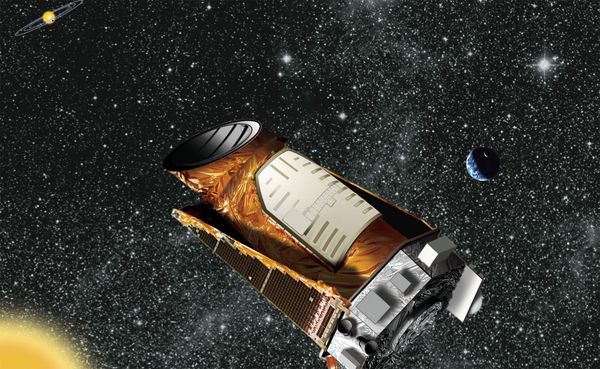
The NASA Kepler spacecraft mission looked at about 156,000 stars simultaneously in a section of the Cygnus constellation to search for Earth-sized exoplanets during a four-year period of time. The spacecraft focused on exoplanets that could be in the stars' habitable zones. Only 0.5% of the stars are expected to have their planets orbits in the habitable zones properly aligned for detection by Kepler. A terrestrial exoplanet with mass between 0.5 to 10 Earth masses will cause its star to dim by a fractional amount of between 0.00005 to 0.0004, respectively, and the transits will last just a few hours. Each exoplanet transit must be repeatable at least two more times after the first detected transit with the same time interval between transits and depth of transit. Such repeatability of the transits would mean that something was orbiting the star and not just some chance occurrence of an unrelated object passing in front of the star. Where Kepler was designed to look deeply at one small patch of sky with one camera, TESS is looking at nearer stars but in all directions, taking two years to survey about 75% of the sky in long strips with four cameras for about a month at a time. The strips overlap at the ecliptic poles, so those regions are under constant surveillance.
 --
--
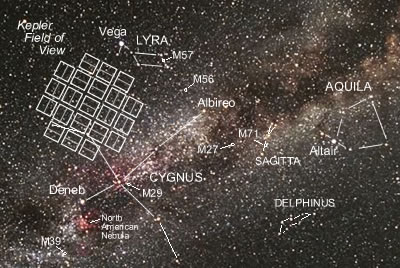
On the left (or top) is the Kepler spacecraft and on the right (or bottom) is Kepler's original field of view in Cygnus.
The video below about TESS summarizes the similarities and differences between TESS and Kepler and shows how TESS will examine nearly the entire sky in narrow strips at a time, each strip for about one month at a time. You can download the video from the TESS website.
For a solar-type star with an exoplanet in the habitable zone, the exoplanet would transit the star once a year. The three-transit detection minimum assumes that the stars are calm and steady like our Sun. The Kepler team found that a number of the stars are a bit more active, more variable, than our Sun, so they got an extension on the mission to get more observations in order to tease out the dimmings due to transiting exoplanets from those due to the intrinsic variability of the stars themselves. The mission extension was to carry the mission through to the year 2016 but hardware failure of a couple of its stabilizer reaction wheels brought the observing of the section of Cygnus to an end in early 2013.
From June 2014 to October 2018, the Kepler mission employed a clever technique that used the pressure of sunlight to help point the telescope with the remaining two stabilizer reaction wheels. This mission called “K2” looked at objects near the ecliptic. In the K2 phase, Kepler looked at other objects in addition to hunting for exoplanets such as variable stars, star clusters, and galaxies. The Kepler team has created some nice interactives showing how the exoplanet detection works as well as how the various planet parameters are derived.
Although the Cygnus and K2 phase observing is finished, the Kepler team still has thousands of transits to sift through, so there are plenty of discoveries still to be made. Using the number of confirmed exoplanets from the candidate list along with the numbers of candidates that were later rejected, we now have a very good idea of how well the Kepler team's transit vetting process works in finding possible planets. Just ten percent of the exoplanet candidates turn out to be something else. That leaves 90% of the exoplanet candidates as actual exoplanets. (See this study of detection efficiency and also this study of automatic classification of candidates.)
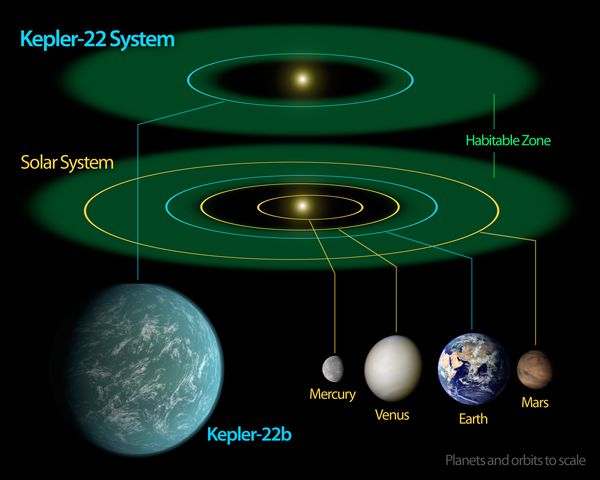
Over 200 of the confirmed exoplanets in the Exoplanet Archive are definitely rocky terrestrial exoplanets with densities 3.0 times or greater than that of water and the size of Earth or smaller. About 30% of the exoplanets in the Archive are Super-Earths. The first rocky exoplanet discovered, called Kepler-10b, has a density of 6.5 times that of water (original measurement had a density of 8.8). However, Kepler-10b orbits less than 0.017 AU from its star (Mercury orbits our Sun at 0.39 AU), so its surface temperature is over 1800 K! The oceans there would be liquid iron. Another confirmed exoplanet, Kepler-22b, is the first one from the Kepler mission known to be in its star's habitable zone. At 2.4 times the diameter of Earth, Kepler-22b is considered to be a “mini-Neptune”, instead of a “super-Earth”. A comparison of Kepler-22b and its star's habitable zone with our solar system is shown in the image below. The picture of Kepler-22b is an artist's imagination of what Kepler-22b might look like. Since the star Kepler-22 is slightly cooler than the Sun, its habitable zone is slightly smaller than the Sun's.
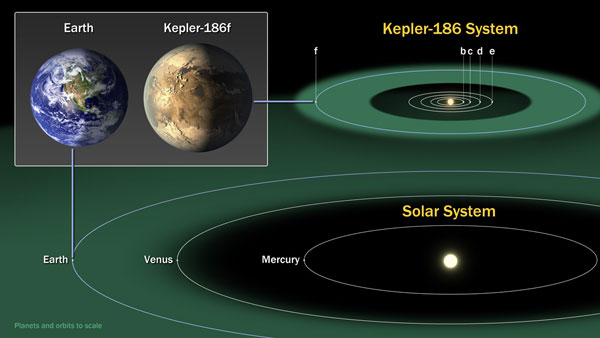
The first confirmed exoplanet the size of Earth in a star's habitable zone is Kepler 186f at just 1.1 times the size of the Earth. If Kepler 186f has the same density as the Earth, it would be a little over 1.3 times the mass of the Earth. The statistics of the known densities of exoplanets plus sophisticated modeling tells us that about 75% of the exoplanets smaller than 1.5 Earth-radii are rocky worlds. Therefore, it is very likely that Kepler 186f is a rocky world composed mostly of silicates, iron, nickel, and magnesium like the Earth. A comparison of the Kepler 186 system's five planets with the inner three planets of our solar system is shown below. Note that the star Kepler 186 is cooler and only 4% the luminosity of the Sun, so its habitable zone is significantly smaller than the Sun's habitable zone.
We can detect exoplanets even smaller than Earth. In the confirmed exoplanet system, Kepler 20, has five exoplanets including two exoplanets that are the size of Earth. Kepler-20e is smaller than Venus and Kepler-20f is just 3% larger than the Earth. Unfortunately, both of them orbit well inside Kepler-20's habitable zone. Another confirmed exoplanet system, Kepler 37, has one exoplanet just slightly larger than the Moon, a second slightly smaller than Venus, and a third that is twice the size of the Earth.
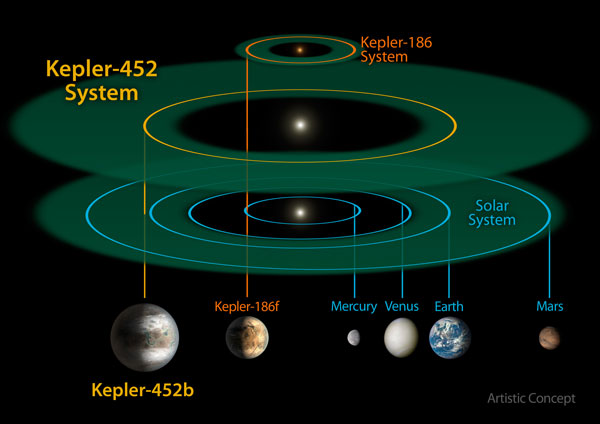
The exoplanet with characteristics most like Earth (planet and host star) is probably Kepler 452b (though there is some controversy of its existence). It is a rocky Super-Earth with 3.29 times the Earth's mass and 1.63 times Earth's diameter, making its density be 4.2 times that of water. The star Kepler 452 is only slightly hotter and larger than the Sun, so its habitable zone is very similar to the Sun's. The exoplanet Kepler 452b is in the habitable zone with a distance of 1.046 AU and orbital period of 385 days. Receiving just 10% more energy than Earth does, its temperature is calculated to be 265 K without taking into account any atmosphere (Earth's temperature would be 254 K using the same calculation). With a surface gravity 1.9 times Earth's, you could still walk around on its surface. Does it have an atmosphere and what is its composition? At a distance of about 1800 light years, it's probably beyond our current capability to get the spectrum of its atmosphere.
Another possible “Earth twin” is in the last data release for the Cygnus field project (before the K2 phase). The Kepler team gave a list of forty-eight exoplanets (28 confirmed and 20 candidates) with diameters less than 1.8 times Earth's diameter that reside within their star's habitable zone. The planet most like the Earth-Sun system is the candidate KOI 7711.01 with a diameter 1.31 times Earth's diameter orbiting its star every 302.8 days. It receives 87% of the energy that Earth receives from the Sun and the star is slightly cooler than the Sun. Although the Kepler team has not found the exact Earth analog of an exoplanet of identical size to the Earth orbiting a star with the same temperature as the Sun at the exact same distance as the Earth is from the Sun, it has become quite clear that there are PLENTY of small rocky-world exoplanets orbiting within the habitable zone of their star in just this one small section of the Milky Way we have searched.
Other statistical results from the Kepler mission include: nature makes planets of a variety of sizes up to 3 Earth diameters with equal ease and has more difficulty with larger planets like Saturn or Jupiter; 22% of sun-like stars (that's 1 in 5) have a planet of 1 to 2 Earth diameters in size orbiting in the star's habitable zone; at least 70% of ordinary stars including those hotter than the Sun and the great majority cooler than the Sun have a planet of some size orbiting them; and about 50% or so of the very common cool stars have a planet between 0.5 to 1.4 Earth diameters orbiting within their habitable zone. That last statistic means that the closest Earth-size exoplanet having its orbit aligned just right with our line of sight so the exoplanet transits its star is just 29 light years away—within very easy reach of the TESS mission.
TESS's first Earth-size exoplanet in a star's habitable zone (announced in 2020) is TOI-700 d that is 1.07 Earth diameters and it gets 85% of the energy that Earth receives. A second Earth-size exoplanet, TOI-700 e in the star's habitable zone was announced in 2023. TOI-700 e is 0.95 Earth diameters and gets 127% of Earth's sunlight. TOI-700 d+e and their two companion exoplanets orbit a cool red dwarf star 101 light years away.
The transit method can usually find just the exoplanet's diameter and the doppler shift technique must be used to determine the exoplanet's mass. In a few systems with multiple exoplanets it may be possible to find the exoplanet masses. The precision of the Kepler measurements are high enough that the Kepler team has been able to detect changes in the exoplanet periods caused by the exoplanets pulling on each other. The exoplanet mass follows from observing the amount of acceleration changes in the exoplanets' motions. This also requires the exoplanets to have closely spaced orbits. One last thing to note is that in order to even see a system with multiple transiting exoplanets at all requires the exoplanets to have very closely aligned orbits, even more closely aligned than the planets in our own solar system—there are some very flat systems out there!
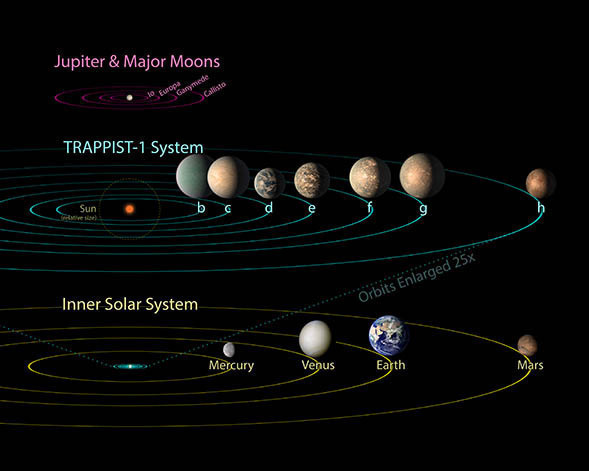
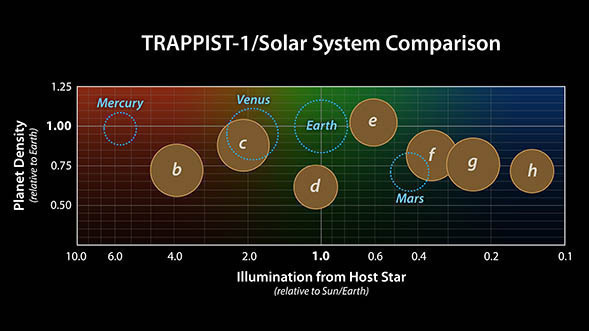
While the Kepler mission was getting most of the media attention, the Spitzer Space Telescope using the transit technique in the infrared revealed in early 2017 that the TRAPPIST-1 red-dwarf star, just 40 light years away, has seven Earth-size exoplanets orbiting it. Three of the planets (TRAPPIST-1c, d, e) are in the habitable zone receiving 2.21, 1.12, and 0.65 times Earth's sunlight, respectively, and the four others could have liquid water if they had just the right atmospheric conditions. The TRAPPIST-1 exoplanets are within 0.062 AU of the star (that is just one-sixth the distance that Mercury is from the Sun), so they are very close to each other. Standing on one planet, its neighbor would appear larger than the Moon in our sky. Their closeness to each other also enables us to get their masses. A year after the announcement, NASA released results from Spitzer, Kepler, and Hubble observations of the TRAPPIST-1 system that showed all the planets are made of rock and some may have much more water than Earth. Hubble observations show that the inner five planets do not have thick, hydrogen-rich atmospheres like Neptune. The James Webb Space Telescope was able to measure the temperature of the innermost planet in the first ever detection of light emitted by a small, rocky exoplanet. The dayside temperature is too warm for there to be an atmosphere of any sort and there are no signs of carbon dioxide which also indicates the lack of an atmosphere. TRAPPIST 1-c also has no atmosphere. Like most small red dwarf stars, TRAPPIST 1 is very active with powerful flares and coronal mass ejections that can strip the atmospheres of nearby planets. Observations are still in process for the other exoplanets in the system.
 --
--
Careful observations of the spectrum of the star while the exoplanet is transiting across (a “transmission spectrum”) enable astronomers to determine the chemical composition of the exoplanet's atmosphere using spectroscopy. In other cases, the exoplanet's spectrum is found from taking the spectrum of the star plus exoplanet, then taking the spectrum of just the star when the exoplanet is behind the star and subtracting it from the star plus exoplanet spectrum. One exoplanet, HD 189733b, has water, methane and carbon dioxide in its atmosphere but the exoplanet is much too hot and massive to support life. It was not until January 2010 that astronomers had been able to take the spectrum of an exoplanet directly (a “direct source spectrum”). This was one of the huge planets in the HR 8799 system discussed above but it is an important step in eventually being able to analyze the spectrum of a terrestrial exoplanet in the habitable zone to see if it is supporting life on it.
Another method of exoplanet detection uses the gravitational lensing effect discussed in the Einstein's Relativity chapter. When a star passes almost in front of another more distant star as seen from the Earth (the stars are not orbiting each other), the light from the distant star can be warped and focused toward us by the gravity of the nearer star to produce multiple images of the distant star or even a ring of light if they are aligned exactly right. This lensing effect is too small and the resolving powers of telescopes are too small to see the multiple images. The multiple images will blend together into a single blurry blob that is brighter than when the multiple images are not present (a microlens event). As the nearer star moves in front of the distant star, the nearer star's blurry blob will appear to brighten and then dim as the nearer star moves out of alignment. The microlens event for typical stars in our galaxy moving at typical speeds will last a few weeks to a few months and the amount of the brightness magnification will depend on how closely the near and distant stars are aligned with our line of sight.
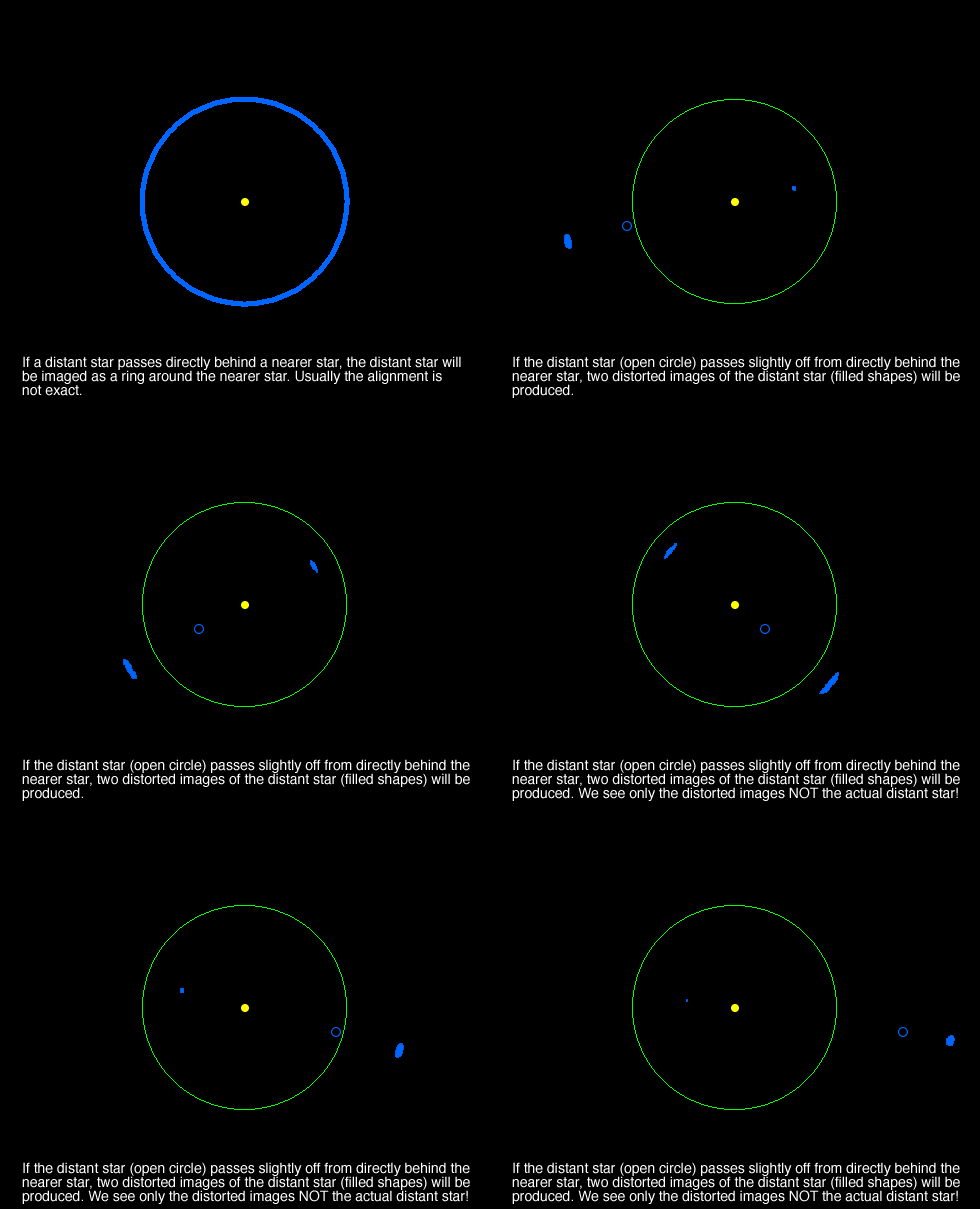
The animation above shows an extemely-magnified view of two possible microlens events (what you would see if you had an optical telescope several hundred meters across in space). The brightness of the ring and the combined brightness of the two distorted images exceed the distant star's brightness when it is not lensed. This animation is adapted from a figure by Penny Sackett in a talk about the search for planetary systems using microlenses.
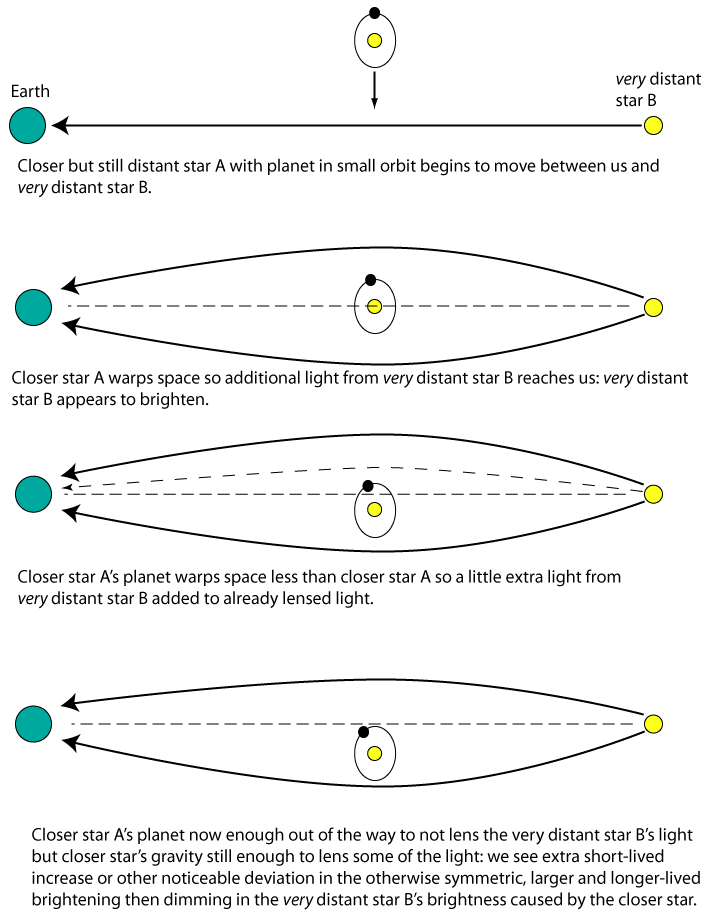
If the nearer star has a planetary system with an exoplanet at the right position, a smaller and briefer microlens event will happen superimposed on top of the star's microlens. By looking for brief deviations in the otherwise smooth increase, then smooth decrease of a stellar microlens event, you could detect the presence of an exoplanet. This method is called the microlens technique and is summarized in the figure below—select the image to view the full-size version in another window. The exoplanet's mass and orbit size could be determined from careful measurements of the brief deviations. The microlens event method can be used to detect Jovian-mass and terrestrial-mass exoplanets near their parent stars and the parent stars are distant from the Earth. Like the transit method, a lot of stars must be monitored to pick up even a single stellar microlens event. The microlens events are due to chance alignments that are not repeatable. About 4% of the exoplanets orbiting stars have been found using the microlens technique .
In May 2011, two teams using the microlens technique announced the discovery of several other exoplanets that are not orbiting a star—“free floaters”. The teams had observed about 50 million stars in the direction of the Milky Way's bulge every 10 to 50 minutes in 2006 and 2007 looking for those chance alignments. They found a surprisingly large number of brightenings caused by planet mass objects alone. A statistical extrapolation of the results says that the free floater planets could be almost twice as numerous as normal main sequence stars in the Galaxy!
The searches have so far focused on stars similar to the Sun, but exoplanets have also been found around other types of stars, from those much larger and hotter than the Sun to stars much smaller and cooler than the Sun, and at least four systems have exoplanets orbiting a pulsar (a type of ultra-compact, dead star discussed in the stellar evolution chapter—exoplanets found using a variation of the doppler shift technique called the timing technique). This section has focused on the four most prolific methods (lumping astrometric and doppler shift together as “star wobble”) for finding exoplanets but there are other techniques. The number of systems discovered and the details about them changes so rapidly that the best place to find up-to-date information on exoplanets is on the internet. Some websites are given at the end of this chapter.
The transit and microlens techniques are not good for looking exoplanets around a particular star of interest. The star-wobble and direct imaging methods are better. However, the transit and microlens methods are useful for determining the statistics of planetary systems in our galaxy, particularly the number of star systems with terrestrial exoplanets in the habitable zones.
|
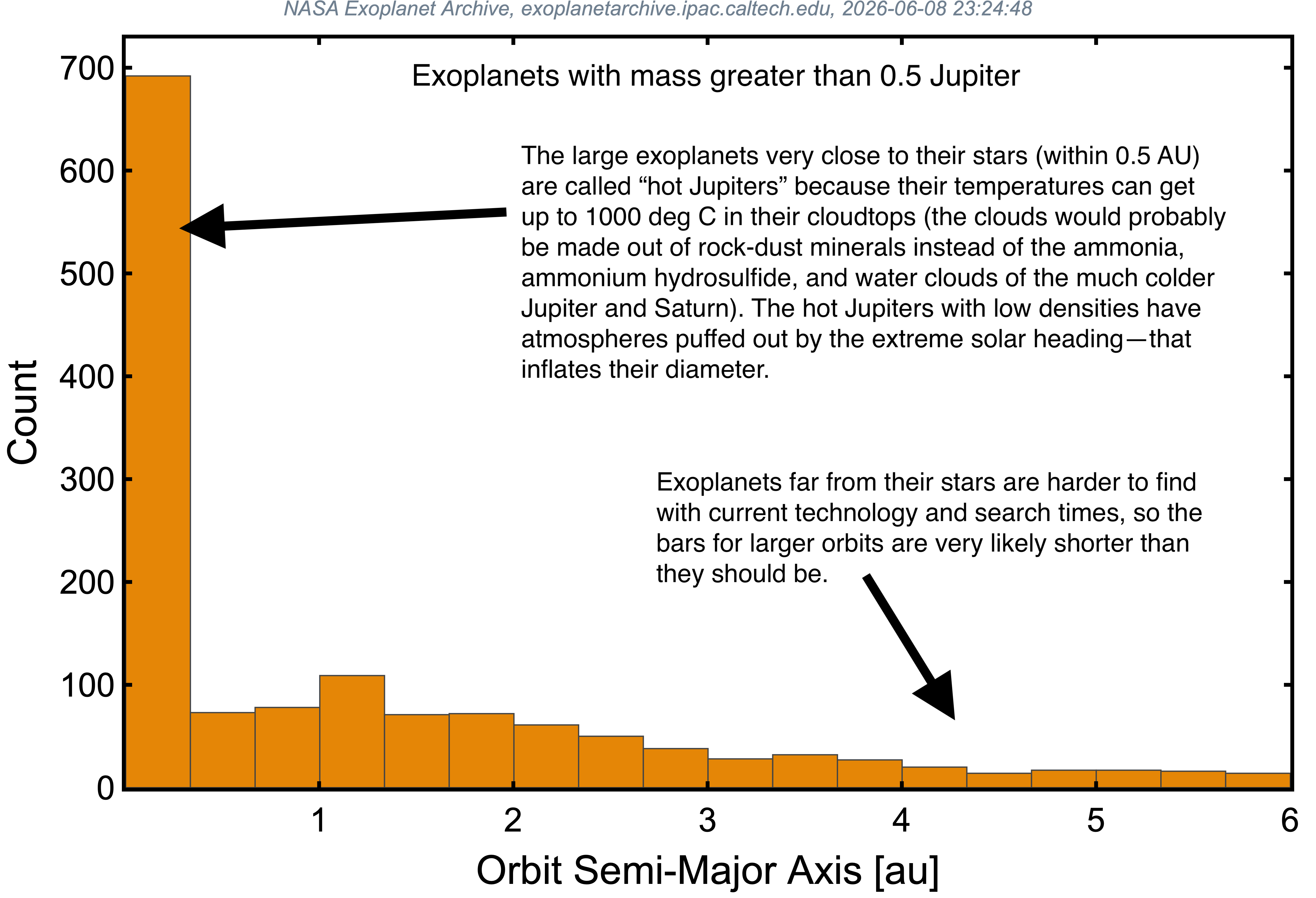
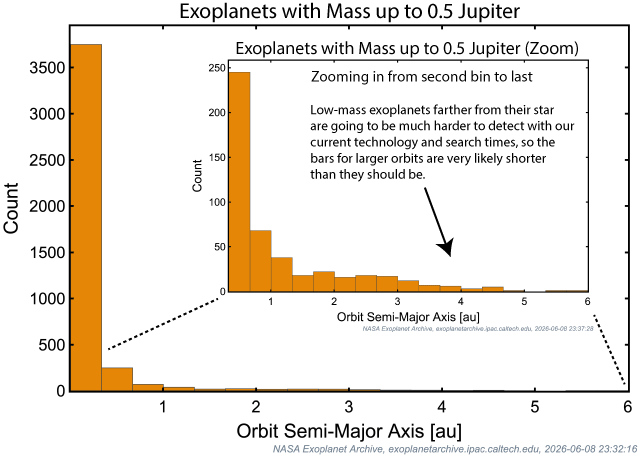
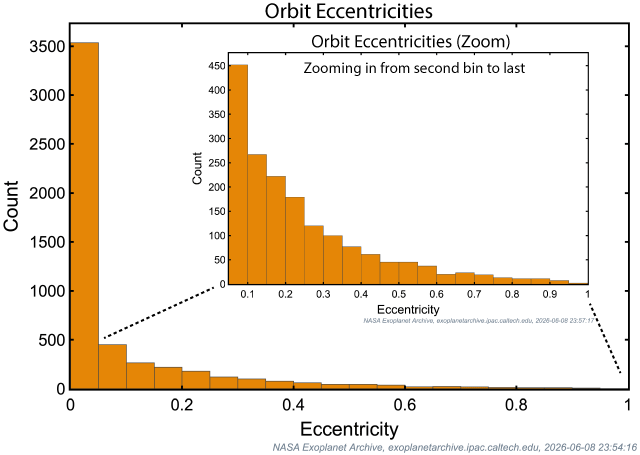
The left set of figures summarizes the orbit sizes of the confirmed exoplanets with known orbit sizes and masses as of June 2026 from the Exoplanet Archive. The top left figure is for the exoplanets with masses greater than 0.5 times Jupiter's mass and the bottom left figure is for the less massive exoplanets. Note that the low-mass exoplanets farther from their star are going to be much harder to detect with our current techniques, so the bars for the larger orbits are very likely shorter than they should be. The right figure above is for the exoplanets with known eccentricities. Most of these exoplanets with known orbit eccentricities are Saturn- Jupiter mass or larger and most of those that transit their star have densities like Saturn-Jupiter or less. Since it is the proportions that really matter (and not the raw numbers), please note that the shapes of the distributions have been very much the same since 2018—the proportions have not changed; only the count number on the vertical axis has changed. Two things to notice are how close the large exoplanets (50% Jupiter's mass or larger) are to their stars and the large eccentricities of some of the exoplanet orbits. The large exoplanets very close to their stars (within 0.5 AU) are called “hot Jupiters” because their temperatures can get up to 1000 deg C in their cloud tops (the clouds would probably be made out of rock-dust minerals instead of the ammonia, ammonium hydrosulfide, and water clouds of the much colder Jupiter and Saturn). The hot Jupiters with low densities have atmospheres puffed out by the extreme solar heating—that inflates their diameter. |
The Condensation Model outlined in the previous section predicts that large planets will only form far from the young star. Giant planets start from a core of rock and ices that were able to solidify far from the intense heat of the young star. The rock-ice cores then pull in surrounding gas by their gravity. Near the star, the temperature is too high to form the rock-ice cores.
Over a decade before the discovery of the first exoplanets, astronomers predicted as part of the Condensation Model that large gas/rock clumps would form far from a young star and spiral inward toward the star because of friction with the gas remaining in the disk around the forming star. The gas/rock clumps can also interact with each other sending one into a small orbit while the other is ejected out of the system. Such interactions may also explain the elliptical orbits we see. Some astronomers working on planet formation models are looking for ways to halt the inward spiral of the gas giant planets near the star through tidal interactions between the planet and star. Perhaps the gas giant planets we see are simply the ones that did not have time to spiral completely into the stars before the gas disk was cleared away by the strong T-Tauri winds that accompany the start of nuclear fusion. Perhaps in our solar system other giant planets had formed but did not survive or were ejected. Evidence for the ejection possibility comes from the potentially large number of free floater planets that the microlens surveys are saying must exist in the Galaxy.
Recent computer simulations of the dynamical history of our solar system show that the gravity of Saturn helped prevent Jupiter from spiraling into the Sun and that their orbits may have started further out than they are now, then moved closer in than they are now, and then finally moved further out to their present distances. The simulations also show that Uranus' initial orbit might have been larger than Neptune's initial orbit and that both planets' orbits were smaller than they are now. This shuffling of the gas giant planets would also have affected the material forming the terrestrial planets and changed the distributions of various types of asteroids and comets. The Kepler mission has provided strong evidence in favor of the inward migration idea for how the hot Jupiter systems formed. A 2012 study looked at over 60 hot Jupiter systems in the Kepler catalog and none of them had multiple planets while other systems with large planets further out can have multiple planets. However, in our continual efforts to test the model and the bounds of what nature makes possible, we have found that while many hundreds of hot-Jupiter systems are single-planet systems, a few systems (less than 10) have a hot-Jupiter and a nearby small planet. We have found one system ( published in 2025), WASP-132 with an inner Super-Earth orbiting the star in just 24.3 hours, a hot Jupiter with orbital period 7.1 days, and an icy giant much farther out orbiting once every five years. Observations of other star/planet formation places and other planetary systems along with more sophisticated computer simulations have confirmed various features of the Condensation Model and they have also led to modifications and extensions of the theory in the continual interaction of the observation-theory-testing error correction process of science. Since the Condensation Model has worked so well after many tests, astronomers approach the handful of exceptions, including WASP-132, as a sign that a “quieter” migration process that doesn't fling out all of the other planets is possible.
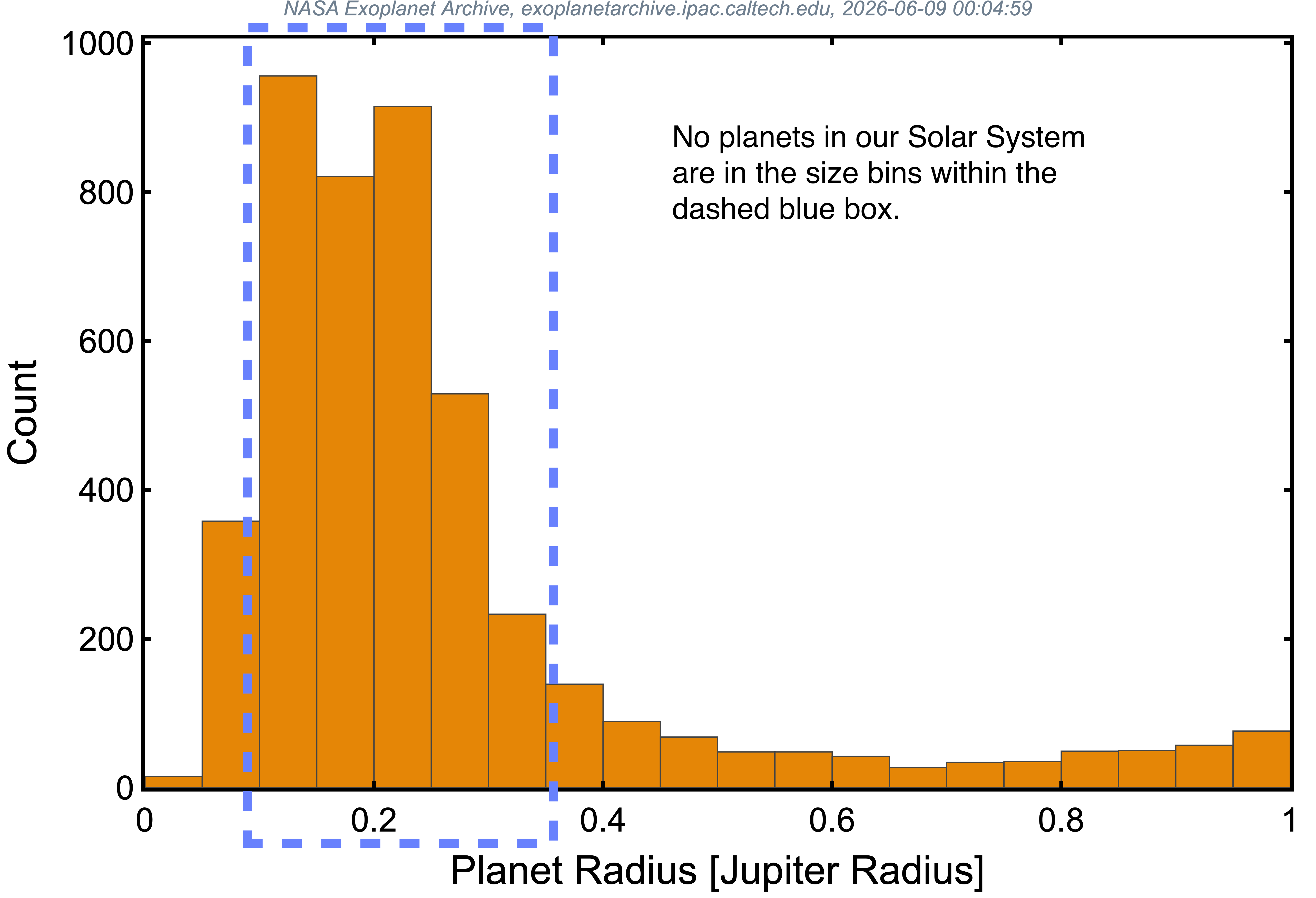
One puzzling statistic from the Kepler mission has to do with the sizes (diameters) of the exoplanets. More than three-fourths of the planet candidates in the Kepler catalog have sizes ranging between that of the Earth and Neptune. Why does not our solar system have a planet in that size range? In that respect, our solar system's architecture seems to be an unusual one in the Galaxy. Further refinement of the Condensation Model will need to be made to explain why super-Earths/mini-Neptunes are so common and what happened in our solar system to prevent such a planet from forming or continue to exist in our solar system. One possibility is that there is, in fact, a mini-Neptune orbiting very far from the Sun that hasn't been found yet. Such a distant but large planet (“Planet Nine”) in our solar system could explain the clustering of orbit properties of recently-discovered scattered disk objects.
In the next few years, ground-based interferometers will be completed that can image large exoplanets. It is unlikely that life could arise on a gas giant planet because of the strong convection in their atmospheres that would move organisms vertically between huge extremes of temperatures. What about Earth-like planets? NASA's proposed Habitable Worlds Observatory (HWO), a space-based mission, will be able to obtain infrared or optical pictures of life-bearing planets. With HWO astronomers will also be able to analyze the spectrum of the planets to determine the composition of their atmospheres. The James Webb Space Telescope is able to take spectra of nearby exoplanet atmospheres. In addition to determining the composition of the atmosphere, Webb is able to measure changes from night to day. Spectral lines from water vapor would say that a planet has a vital ingredient for life but it does not mean that life is present. If oxygen, particularly ozone (a molecule of three oxygen atoms), is found in the atmosphere, then it would be possible that life is indeed on the planet. This is discussed further in the Bio-Markers section of the Life in the Universe chapter along with the possibility of oxygen being a “false-positive” sign of life. The setup and technologies a mission like HWO will employ will be based on the experience gained from previous projects such as the Keck Interferometer, the Large Binocular Telescope Observatory, Kepler, TESS, CoRot, NESSI spectroscopy of nearby exoplanets, the Gaia Mission, the Hubble Space Telescope, the James Webb Space Telescope, and the Grace Roman Telescope. Unfortunately, the soonest that HWO could launch would be sometime in the 2040s.
| astrometric technique | center of mass | direct imaging technique |
|---|---|---|
| doppler shift technique | exoplanet | microlens technique |
| transit technique |
last updated: July 12, 2026
 Go back to previous section