This material (including images) is copyrighted!.
See my copyright notice for fair use
practices. Select the photographs to display the original source in
another window.
Jupiter holds a special place in history because of the discovery by
Galileo in 1610 of four large moons orbiting it. This observation gave Galileo
strong evidence against the popular Earth-centered universe of his day.
Like the Earth, Jupiter was a planet with moons orbiting it. Galileo took
the Jupiter system to be like a miniature solar system. These four
satellites are called the Galilean satellites in honor of their
discoverer. In order of increasing distance from Jupiter they are Io, Europa,
Ganymede and Callisto. Since then, 97 other moons have been discovered
orbiting Jupiter. The Galilean satellites are of particular interest here.
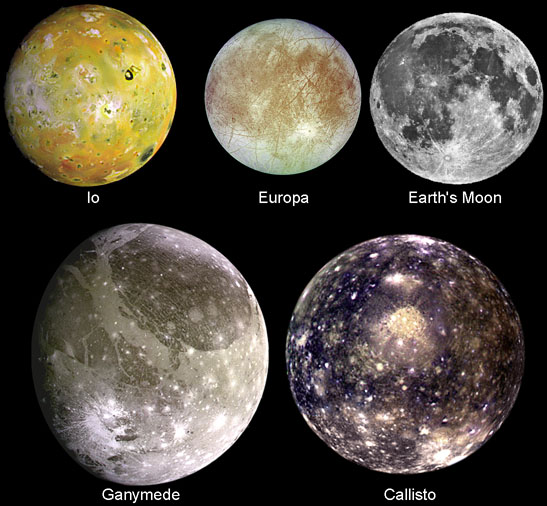
The
Galilean satellites (Jupiter's four largest moons) to the same scale.
Our Moon is also shown for reference.
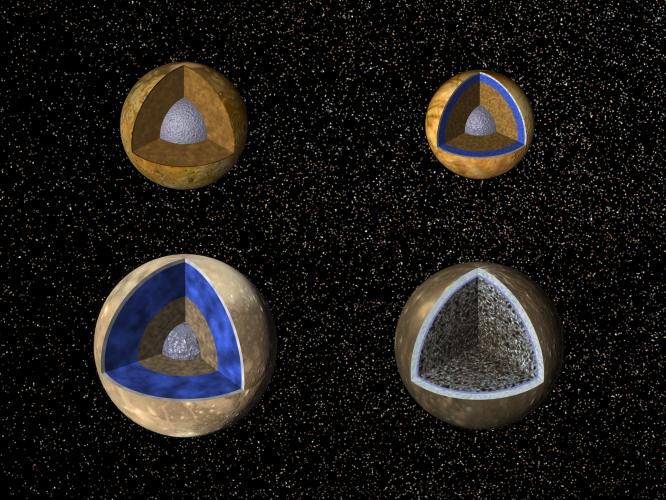
Cutaway views of the possible internal structures of the Galilean
satellites. Clockwise from top left: Io, Europa, Callisto, Ganymede. See the
text below for information about the internal structure.
The Galilean moon closest to Jupiter is Io. Io has a iron-nickel core surrounded by a rock shell that extends all the way to the surface. Io has no impact craters even
though it has a rocky, solid surface. The surface must be very young
because something has erased the impact craters. Even though Io has nearly
the same size (3643 km across) and density (3.53X water) as the Moon, Io is the most geologically active
world in the solar system. Io has many volcanoes and all of its craters
are volcanic in origin. It is so active despite its small size because of
the enormous stresses it experiences from Jupiter.
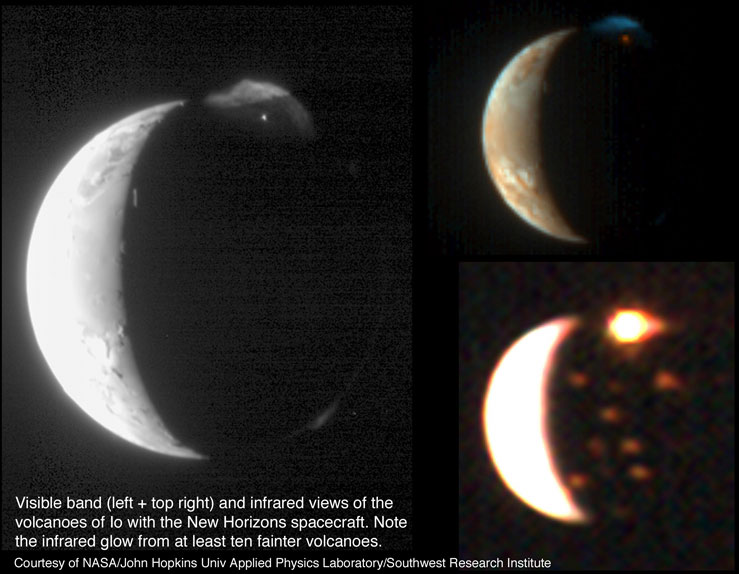

Image above is an infrared image taken of Io by the Juno spacecraft in July 2022 when it was just 80,000 kilometers from the moon. That closer distance resulted in a higher-resolution image than what New Horizons saw in the previous image above when New Horizons was 2.3 million kilometers from Io.
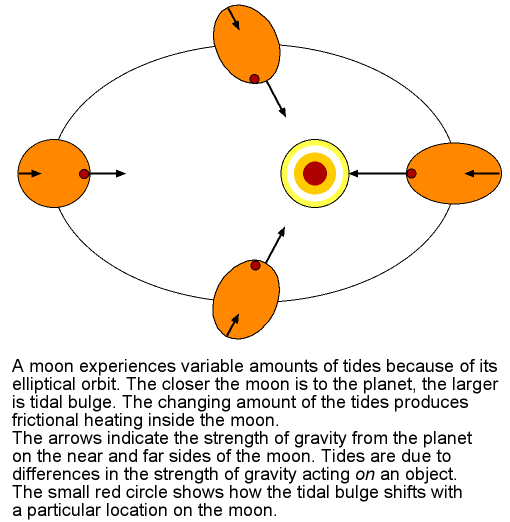
Even though Io is about the same distance from Jupiter as the Moon is from
the Earth, Io experiences much stronger tidal stretching because Jupiter is
over 300 times more massive than the Earth—Io's rock surface bulges up and down by as much as 100 meters! Io also takes 1.77 days to orbit Jupiter—compare that with the 27.3 days that the Moon takes to orbit the Earth.
Io's orbit is kept from being exactly circular by the gravity of its Galilean
neighbor Europa and the more distant Ganymede. Io, Europa, and Ganymede have a 4:2:1 orbital resonance that keeps their orbits elliptical. For every four orbits of Io, Europa orbits twice and Ganymede orbits once. Io cannot keep one side
exactly facing Jupiter and with the varying strengths of the tides because
of its elliptical orbit, Io is stretched and twisted over short time periods. The tidal flexing
heats Io's interior to the melting point just as kneading dough warms
it up.
The heat escapes through powerful eruptions spewing sulfur
compounds in giant umbrella-shaped plumes up to almost 300 kilometers above
the surface. The tidal heating from Jupiter has driven away much of the
volatile materials like water, carbon dioxide, etc. Io's surface is a
splotchy mixture of orange, yellow, black, red, and white. The colors are
created by sulfur and sulfur dioxide at various temperatures in liquid and
solid states. Io has a very low density, rarefied atmosphere consisting of just an exosphere layer made of sulfur dioxide molecules.
A note of caution before proceeding further: although heating of the interior by tidal effects
is a significant reason why some of the moons of the Jovian planets exhibit geologic activity, it is not
the only reason. Tidal heating cannot explain all or any of the activity seen on some of the icy moons.
Other mechanisms such as rotational shearing from a wobbly rotation axis can play a role. Ultimately, it
is the composition of the icy moons that makes the difference. The ices are able to deform and melt at
lower temperatures than the silicate and metal rocks found in the inner terrestrial planets and their
moons.
The next moon out from Jupiter is the smooth, white moon called Europa. It
is smaller than Io (3122 km across) and has a density of 3.01X water. Europa
is of particular interest to astronomers because of what is below its ice
crust. Europa has an iron-nickel core and a rocky mantle surrounded by a deep ocean of liquid water, 100 kilometers deep,
that is frozen on the surface.
The Galileo spacecraft provided high-resolution images of its
surface and showed giant blocks of ice that appear to have been broken
off and floated away into new positions—see the image below. Below is a false-color image to highlight the differences in the surface. Reddish-brown areas represent non-ice material resulting from geologic activity. Dark blue areas are coarse-grained ice plains and light blue are fine-grained ice plains. The long, dark lines are ridges and fractures some of which extend more than 3000 kilometers that result from tectonic activity.
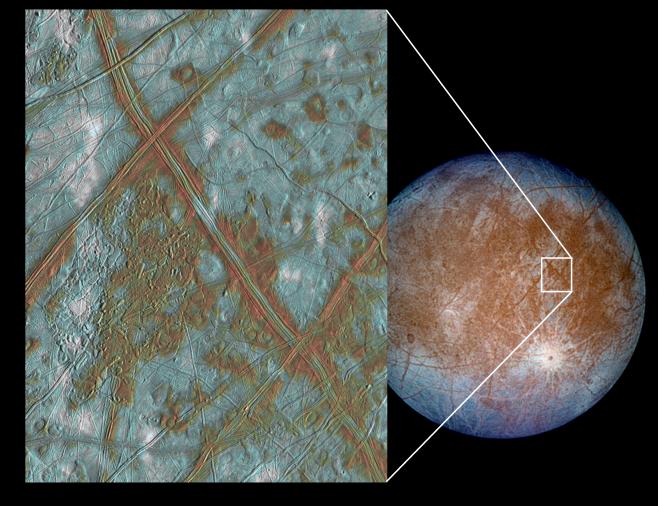
Europa has no impact craters which means
the surface is very young. Depending on the assumptions of whether it is asteroids or comets pelting the surface, Europa's surface might be as young as 100 million years old if asteroids make the craters or still have activity today if comets make the craters. Dirty liquid water from below the ice crust probably wells up through the cracks to cover up older features on the surface and quickly freezes. The Galileo spacecraft found that Jupiter's magnetic field at Europa changes in strength as Jupiter spins. A changing magnetic field can produce electrical currents in a salty ocean that will in turn produce a magnetic field to counter Jupiter's magnetic field (something called Lenz's Law). The presence of an induced magnetic field at Europa is a strong argument for the presence of a salty global ocean.
Europa is farther from Jupiter than Io, so the
tides it feels from Jupiter's enormous gravity are less. It takes about 3.5 days to go around Jupiter in its elliptical orbit. Weaker tides over a longer time period mean the
tidal flexing is less than what Io experiences, but the calculated amount of tidal heating at Europa could be enough to maintain liquid water. Europa is too small for radioactive decay in its rocky core to provide enough heating. Geological activity on the moons of the Jovian planets, even those smaller than Europa, is possible not only because of tidal heating but also because of their composition. Ice melts and flexes at lower temperatures than rock. The flexing of the ice
from changes in the tides, as it moves around Jupiter in its elliptical
orbit, creates an impressive system of cracks on the surface. The cause of
the dark colors of the cracks is unknown, but it may be due to organic
materials or salts.
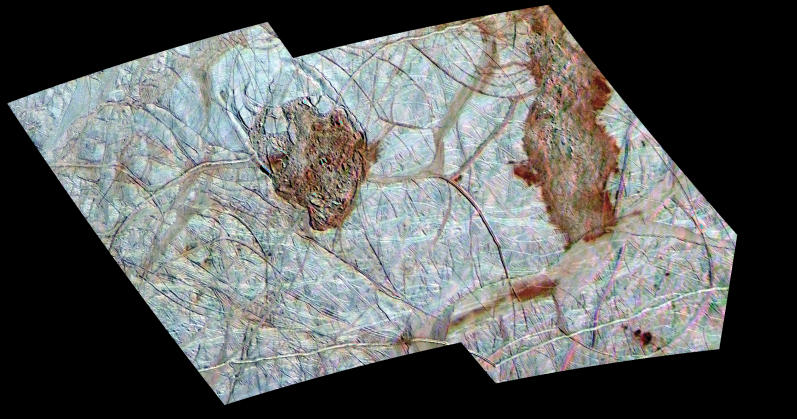
Careful observations of how the Galileo spacecraft moved in Europa's gravity field enabled scientists to determine the ocean thickness. The ocean of liquid water below Europa's icy surface may extend down
several tens of kilometers (or more). More importantly, the pressure at the ocean bottom could still be small enough that the liquid water could be contact with the rocky mantle that could supply nutrients for life. Could life forms have developed in
the warm waters below the icy surface?
 --
-- 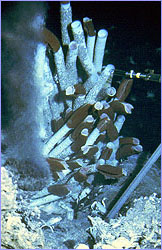
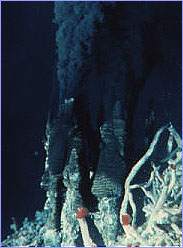
Discoveries of fish, albino
crabs, and 10-foot-long tube worms huddled around active volcanic vents on
the Earth's ocean floor far below where the sunlight energy can penetrate
has bolstered the view that Europa could harbor life below its icy surface
away from sunlight. Before the discovery of life around the geothermal
vents, scientists thought that all life depended on sunlight. Bacteria on Earth have been found to exist in rock a few
kilometers below the sea floor and land surface. Clearly, life is
more versatile than originally thought. Europa is the most likely place in our solar system for current life to exist beyond the Earth, even more likely than Mars.
A spacecraft orbiting Europa could derive the thickness of the ice shell from how much Europa bulges with the
changing tides as it orbits Jupiter. A thicker ice shell is stiffer and will not bulge as much as a thin ice
shell. See the EJSM video for a
visualization of how this would work. However, because Europa is so close to Jupiter, it would take a huge amount of
fuel to slow down a spacecraft enough for Europa’s weak gravity to snatch it away from Jupiter’s gravitational
grip and have the spacecraft orbit Europa instead of Jupiter. In addition, Europa is right in the midst of
Jupiter’s powerful radiation belts of Jupiter’s inner magnetic field, so all of the charged particles would
quickly fry the electronics of a spacecraft orbiting Europa.
The Europa Clipper mission,
which launched in October 2024 and will arrive at Jupiter in April 2030, will orbit around Jupiter in huge
looping paths that make only brief forays into the harsh radiation environment to scan Europa. The current
mission plan is for nearly 50 flybys of Europa in a three-year period but if the electronics and funding
last, there could be mission extensions allowing more flybys. Europa Clipper
will use an ice penetrating radar to determine the thickness of the moon's icy shell and search for subsurface lakes similar to those beneath Antarctica. Further investigation of the Galileo data in 2011 showed that there may be large shallow lakes within the top ice layer that could provide a way of exchanging material between the surface and the ocean beneath. That would make Europa more habitable even if the top ice shell is thick.
The Hubble Telescope might have detected signs of plumes from geysers erupting on Europa
similar to what we find on Saturn's moon Enceladus but there is quite a bit of
uncertainty with the ultraviolet images used to make the claim (the images have a lot of noise in them). A
new analysis in 2018 of data collected by the Galileo orbiter's magnetometer in 1997
shows that a brief, localized bend in the magnetic field could be explained by Galileo passing through a
geyser plume. Charged particles in Jupiter's magnetic field hit Europa's icy surface and the geyser
particles to create a very low density, rarefied atmosphere (i.e., like chipping off individual molecules
from the ice that are then free to move around as a gas). The super-rarefied atmosphere consists of just
an exosphere layer of oxygen molecules. The 2018 analysis also shows that the Plasma Wave Spectrometer's
measurements of plasma waves from charged particle in gases around Europa's atmosphere could be explained
by Galileo passing through a geyser plume. The Europa Clipper could sample the frozen liquid and dust
particles by flying through a plume. See the Europa Clipper mission's
“Why Europa?” section for more details about Europa.
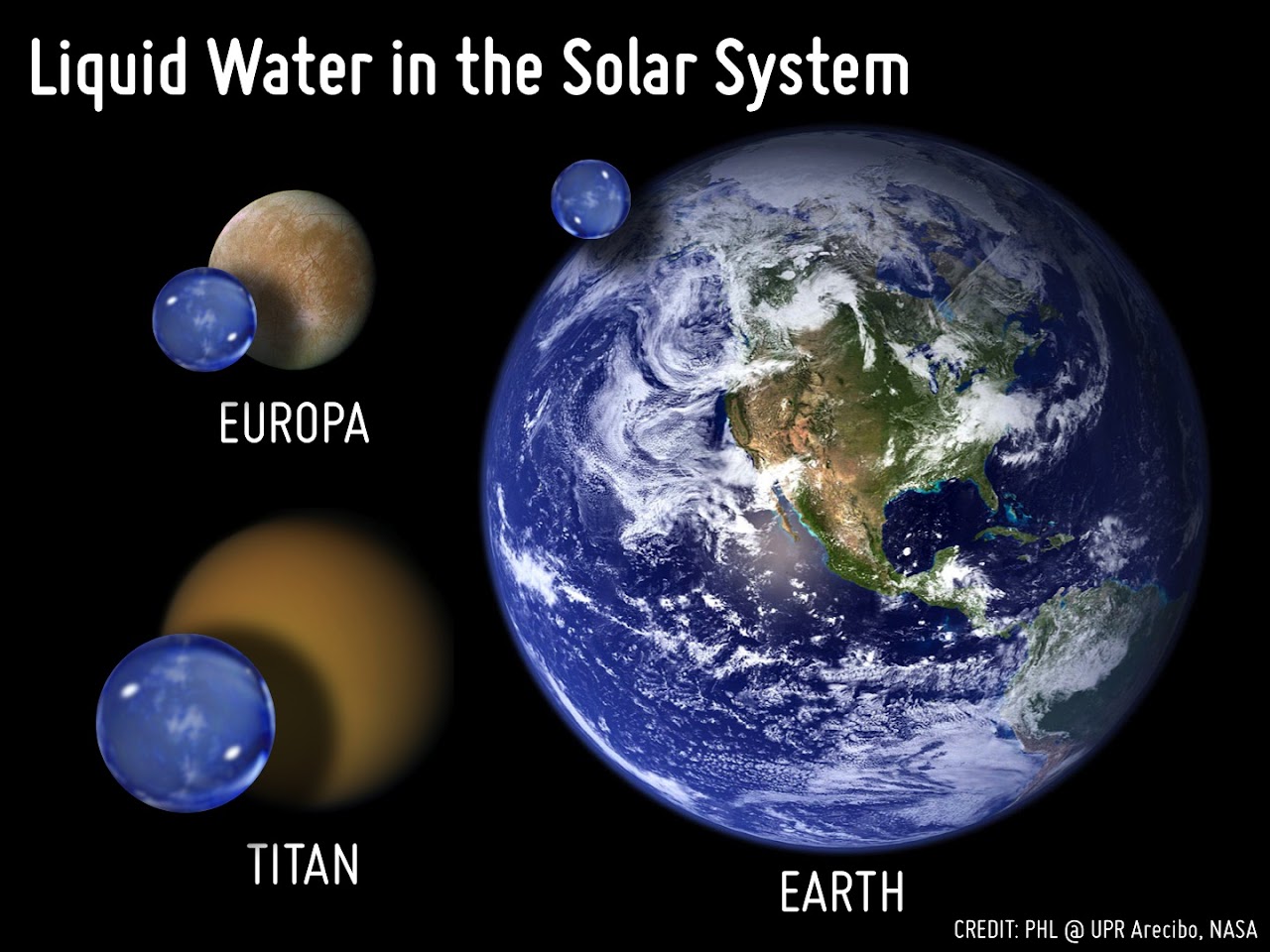
The graphic below compares the amount of liquid water thought to be present on Europa and Saturn's largest moon, Titan, in comparison with Earth. Europa could have over two times the amount of liquid water as Earth and Titan could have over 11 times the amount of liquid water.
The largest of the Galilean satellites (and the largest moon in the solar
system) is Ganymede. At 5262 km across, Ganymede is larger than Mercury but because Ganymede orbits a planet, it is classified as a moon. Ganymede orbits Jupiter in 7.15 days. Its density of 1.94X water shows that it
is made of half rock and half water ice. Its water ice composition enabled it to be more geologically active than Mercury—ice melts and flexes at a lower temperature than rock and metals of the inner terrestrial planets (and the Moon). Ganymede has
bright grooved areas with few craters right next to much older dark areas with more
craters. The bright, parallel ridges may have been caused by a plate
tectonic process that was short-lived. Water may have gushed forth or ice
squeezed up between the plate margins. Craters on the parallel ridges and
older dark areas indicate that Ganymede's geological activity probably stopped
hundreds of millions of years ago.
The Galileo spacecraft detected a magnetic field generated by Ganymede itself as well as an induced one
from the varying Jupiter magnetic field strength at Ganymede. The internally generated magnetic field is
probably generated by convection in a liquid iron core heated by radioactive decay and tidal heating. Ganymede's
orbit is kept slightly eccentric because of the 4:2:1 orbit resonance it shares with Europa and Io so the
tides do vary in strength. The induced magnetic field is evidence for a liquid water layer. At great
enough pressures, water will turn solid. Ganymede's water layer is hundreds of kilometers thick and may be
arranged in multiple alternating layers of ice and liquid water as shown in the figure below. The lowest
layer could be liquid in contact with the rocky mantle and, therefore, possibly any nutrients needed for
life. At the center of Ganymede is an iron-nickel core. Charged particles in Jupiter's magnetic field hit
Ganymede's icy surface to create a very low density, rarefied atmosphere that consists of just an
exosphere layer of oxygen molecules and hydrogen.

The second largest of the Galilean satellites (4821 km across) and the farthest from
Jupiter is the heavily-cratered moon called Callisto. Callisto orbits Jupiter in 16.7 days. It has a density of
1.83X water, so it has proportionally more frozen water
surrounding a smaller rocky core than
Ganymede. Callisto's surface does not appear to have undergone any sort of
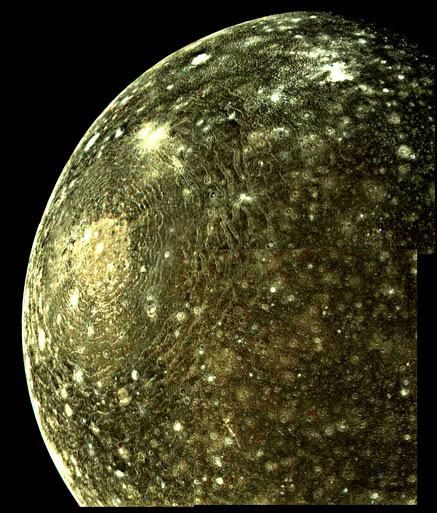
geological activity because of the lack of tidal heating. Its interior is partially differentiated—ice layer on top and a rock and ice mixed together core. Callisto has a huge impact site called Valhalla that
was produced about 4 billion years ago. When the asteroid hit Callisto, it
exploded on impact. The explosion heated the ice to above the melting point
and the shock waves produced a ripple pattern away from the impact site.
The ripples later froze so Valhalla now looks like a big “bull's eye”. Like Ganymede, Callisto has a very low density, rarefied atmosphere created by charged particles hitting the icy surface. Its atmosphere consists of just an exosphere layer of oxygen and carbon dioxide.
Callisto has an induced magnetic field, so it may have a salty liquid water ocean layer beneath its ice crust. The side opposite Valhalla shows no grooves or hilly terrain as one would expect for a stiffer material (as for example, what we see on the opposite side of Mercury from its giant Caloris impact basin). A liquid water layer might explain how the shock waves from the Valhalla got dampened out by the time they reached the opposite side of Callisto.
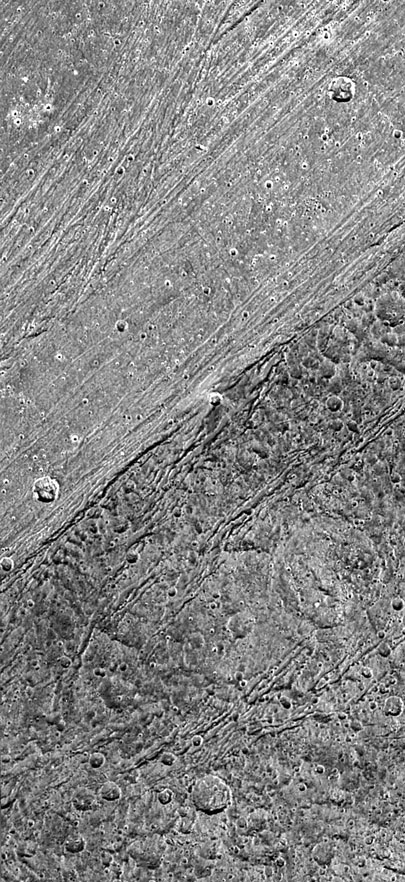 |
(left) Boundary between an ancient, dark terrain (bottom) and
younger, brighter fracture zones (top) on Ganymede as seen by Galileo. (right) The
giant impact feature on Callisto called Valhalla is just above center left
of this image taken by Voyager. The image has been enhanced to highlight
the ripple pattern from the impact. Images courtesy of NASA/JPL |
 Go back to previous section --
 Go to next section
last updated:
May 31, 2026
Is this page a copy of Strobel's
Astronomy Notes?
Author of original content:
Nick Strobel