
Video lecture for Geology section
Terrestrial planet interiors are composed of three basic parts: a dense, metallic core, a lower density solid mantle surrounding the core, and a solid outer shell called the crust. You can use a boiled egg as an analogy for the scale of this layered structure: the egg's yolk would be the core, the egg white would be the mantle, and the egg shell would be the crust. Jovian planets have a core and a fluid mantle that merges smoothly into their atmospheres.
I have already discussed several observations and techniques you can use to get initial clues of what a planet's interior is like. I will summarize them and then discuss ways to increase the accuracy of those rough initial models. Methods and observations already mentioned are:
Astronomers have several other tools to probe the interiors of planets. By carefully observing the rotation of a planet, you can detect the precession (wobbling) of its rotation axis (the precession of the Earth's rotation axis is discussed in the coordinates section of the Astronomy Without a Telescope chapter). The rate of precession depends on a parameter called the moment of inertia which tells you how much the mass is concentrated toward the center. The Earth's core is considerably denser than its surface. The Jovian planets have even greater concentration of their mass at their cores than the Earth does. Tiny twists in a terrestrial planet's spin can be used to determine if the core is solid or liquid. For example, the tiny twists in Mercury's spin rate are too great to be caused by a completely solid core, so its core (or parts of it) must be liquid. You can illustrate this by comparing the spin of a raw egg and the spin of a hard-boiled egg—you will notice that the raw egg's spin slows down because of the fluid inside sloshing about. The Mars InSight lander included this technique in its suite of methods to probe Mars' interior.
The mass distribution of a planet can be probed by observing the motions of satellites (moons or spacecraft) in the planet's gravitational field. Mass lumps in the surface layer can be detected, as well as, asymmetries in the overall mass distribution. For example, the center of the Moon's mass is 2 kilometers closer to the Earth than the center of its overall shape (the geometric center). The Moon's crust on the Earth-facing side is several kilometers thinner than the crust on the far side. This is probably a remnant of the Earth's gravity acting on the early Moon's molten interior billions of years ago. Mars' center of mass is north of the geometric center. This is associated with the fact that Mars' southern cratered highlands stand about four kilometers higher than the northern volcanic plains. The GRAIL mission that orbited the Moon and the GRACE mission that orbited the Earth measured their respective object's gravity field by very precise measurements of the distance between two spacecraft in the same orbit around the body, one trailing the other. With this technique, lumps in the gravity field cause the distance between the two spacecraft to change slightly as each leading spacecraft experiences slightly different acceleration than that felt by the trailing spacecraft. The GRACE spacecraft orbited long enough (over fifteen years) to even map decreases in the amount of land ice near the poles and decreases in the amount of water in aquifers through the pumping of the water for agriculture. The GRACE-FO mission launched in 2018 has continued the measurements of Earth's gravity field and California's Department of Water now uses GRACE & GRACE-FO data in its management of groundwater. The gravity field of Mercury was mapped by the single MESSENGER spacecraft. Measurements of changes in the speeds of the three NASA spacecraft orbiting Mars have been used to make gravity field maps of Mars. The Juno spacecraft started mapping Jupiter's gravity when it began orbiting Jupiter in July 2016.
Planet interiors are warmer than outer space, so energy will flow outward from the interior toward the surface. There are three possible sources of heat in a planet's interior. One is the heat of accretion during its formation—dust, pebbles, and rocks stuck together as they were gravitationally attracted together in the planet's formation, releasing gravitational potential energy. A second source is during differentiation—loss of gravitational potential energy as the denser material sunk to the core. Both of those sources occur early in a planet's history. The primary source today for the terrestrial planets, billions of years later, is the heat from radioactive decay of unstable atomic nuclei: Uranium-238, Uranium-235, Thorium-232, and Potassium-40. The heat in a terrestrial planet's rock/metal interior is not from the great pressures as happens in a gas because the rock/metal are compressed only slightly—a chunk of granite from the surface would be compressed to half its size at the base of the mantle. Rock in the deep interior will eventually become cold at the same high pressure as before.
Energy flows from hot to cold places through radiation (glowing), convection (bulk motions of the fluid), and conduction. Radiative energy transfer is not used in rock because light cannot pass through it, convection occurs in the core and mantle, and conduction occurs very slowly in the crust and the top of the mantle below the crust and is much faster in the metallic core. Radiative energy transfer happens at the surface where the infrared energy photons can travel with much greater ease through the atmosphere to space.
The rate of heat loss from the warm interior and the rate at which the temperature increases at greater depths closer to the core are important parameters for determining the interior structure. On the Earth, scientists can drill several kilometers into the crust and measure the temperature difference between the bottom of the hole and near the top. The Mars InSight was supposed to bore a temperature probe almost 5 meters into Mars' surface to measure the temperature profile down to that depth but the soil beneath InSight clumped more than expected, reducing the friction needed for the bore drill to work. For the Jovian planets, infrared telescopes are able to detect their large heat flows.
For the terrestrial planets, the most useful data comes from seismology—the study of the interior from observations of how seismic waves (“planetquake” waves) travel through the interior. Seismic waves slightly compress rock or cause it to vibrate up and down. They are produced when parts of a planet's crust suddenly shift and can be felt on the surface as a quake. These quakes have been studied extensively on the Earth, so I will focus on the use of earthquakes in what follows but remember that the same principles can be applied on any solid surface where instruments, called seismometers, are placed to study the jolts. Seismometers were left on the Moon by the Apollo astronauts and the Viking 2 lander on Mars had a working seismometer but persistent buffeting by the martian winds prevented it from being able to definitely detect any marsquakes (the seismometer on Viking 1 did not work). No seismometers have been placed on Venus or Mercury. The Mars InSight lander had a very sensitive seismometer.
The speed, amplitude, and direction the seismic waves move depend on the particular type of wave and the material they pass through. Just as a physician can use an ultrasound to get a picture of your anatomy or of a fetus, you can use seismic waves to get a picture of the Earth's interior (though it is a bit cruder than the physician's ultrasound). Earthquakes will produce two main types of waves: P (pressure) waves and S (shear) waves.
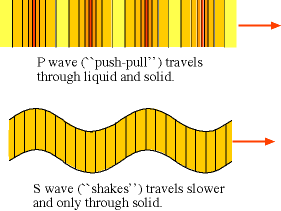
P waves are like sound waves—matter in one place pushes against adjacent matter compressing it. The result is a series of alternating stretched and compressed rock propagating in the same direction as the compression. It is like what happens when you stretch out a Slinky horizontally on a long table and give one end a sudden horizontal shove. You will see a wave of compressed metal coil move across the length of the Slinky to the other end. P waves can travel through solid and liquid material and move faster than S waves.
S waves are like waves in a jerked rope—matter moves up and down or side to side. Liquid matter prevents S waves from spreading. Timing of the arrival of seismic waves from at least three stations in a triangular array allows the earthquake center to be located. Seismometers on the opposite side of the Earth from the earthquake detect only P waves so there must be liquid material in the Earth's core. The size of the liquid core can be constrained from how far away a seismometer can be and still detect both S and P waves.
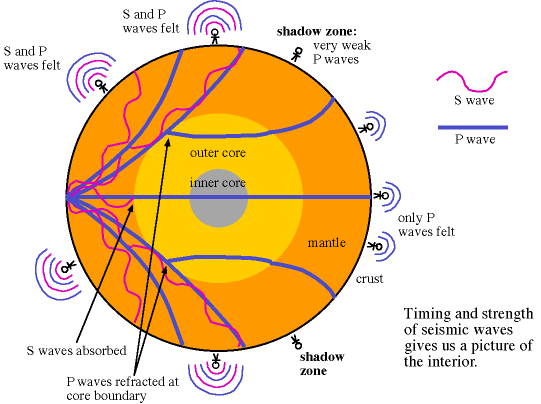
Seismic waves refract (bend) inside the Earth because of the change in speed of the waves as they move through material of variable density, composition, and temperature. Abrupt changes in direction occur at the boundary between two different layers. P waves entering the core are bent toward the Earth's center so they only reach the part of the Earth's surface opposite the earthquake. There is a shadow zone between the P waves that pass through the mantle only and those that pass through the mantle and the core. The shadow zone location also puts constraints on the size of the liquid core. It has a radius of about 3500 kilometers and is made of an iron-nickel alloy with a small percentage of sulfur, cobalt, and other minerals and has a density of around 12 (water = 1). Very weak P waves are felt in the shadow zone, indicating that a smaller solid component resides at the very center with a radius of about 1300 kilometers and a density around 14. Even though the temperature of the interior increases toward the center (it is about 6300 K at the center), the high pressures in the inner solid core (up to 3.64 million bars at the center) make it solid while the outer metallic core remains liquid.
The Earth's mantle is made of hot but not quite molten iron-rich silicate and magnesium minerals like olivine, pyroxene, modified spinel, spinel, perovskite (primarily crystals of a dense form of magnesium silicate), and postperovskite (even denser magnesium silicate) and is around 2900 kilometers thick. Geologists further sub-divide the mantle into an upper mantle below the crust about 625 kilometers thick and a lower mantle 2300 kilometers thick. The upper mantle is made of in order of increasing depth olivine and pyroxene, modified spinel, and spinel layers. The lower mantle is made of a perovskite layer 2000 kilometers thick on top of a thinner 300-kilometer thick postperovskite layer just above the core. The density increases from about 3.5 below the crust to over 5 at the core boundary. The temperature at the top of the mantle below the crust is about 1700 K to about 3100 K at the base of the mantle—not hot enough to liquify the rock at the pressures inside the mantle (about 1.36 million bars at the base of the mantle next to the core). Even though the mantle is not liquid, it can deform and slowly flow when stressed. Convective motions in the mantle rub on the crust to produce earthquakes and volcanoes. This convective motion is very slow compared to a human lifetime, it can take several tens of millions of years for a chunk of rock to move from the inner boundary of the mantle to just below the crust.
From these observations and knowledge of the physical laws of nature, astronomers can construct and refine computer models of the planet interiors. The three parameters of pressure, density, and temperature determine the state of the material and a relation called the equation of state relates the three parameters to each other. It tells what the density is for a given pressure and temperature. For rock, the equation of state is complex and somewhat uncertain. Rocky materials of different compositions and phase or state of the material (solid, liquid, gas) all will have different equations of states. (In contrast, the equation of state for stellar interiors is fortunately much simpler—see the Stellar Structure chapter for a discussion of the equation of state in stars.)
Planets exist in a balance between the compression of gravity and the pressure of the liquid and solid. Deeper layers experience more compression from the overlying material so the balancing outward pressure must increase. (This principle can also be applied to the gas of atmospheres to show why the atmosphere is thicker closer to the surface.) The computer model calculates the density in each layer from the equation of state with appropriate values of the temperature at that depth. The computer program starts off with the observed surface conditions and layer-by-layer, works its way toward the center. If the model does not arrive at a value of the total planet mass by the time it reaches the center, it must be revised. The models are checked against the other observables described above (moment of inertia, oblateness, gravity field measurements, heat flow, etc.) and refined further.
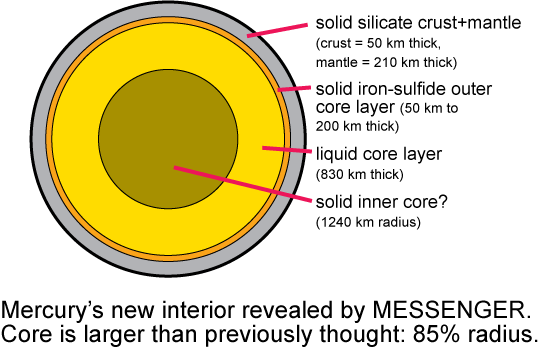
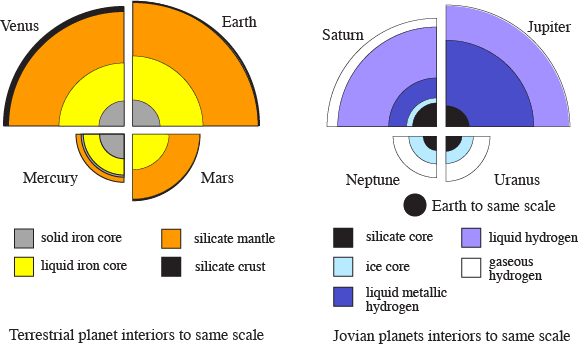
What follows is a brief description of the other planet interiors found from putting all of the observations and theory together (see also the summary figure below). Mercury has a very large iron core that is about 85% of its radius surrounded by a thin silicate layer (crust and mantle) only 260 kilometers thick. Its metallic core is unusual in that it has a liquid layer sandwiched between two solid layers. Its core must also contain some lighter element such as sulfur to lower the melting temperature. The thin, solid iron-sulfide outer core layer is probably responsible for damping Mercury's magnetic field from that expected from the amount of the liquid metallic part of the core.
Venus's interior is very much like the Earth's except its iron-nickel core probably makes up a smaller percentage of its interior. The InSight mission and an earlier gravity field map show that Mars has a molten iron-sulfide core 3660 kilometers in diameter up to 2000 K in temperature, surrounded by a silicate mantle about 1530 kilometers thick and a rocky crust that is 20 to 37 kilometers thick, depending on if there are two or three sub-layers in the crust.
The crust and the outermost part of the mantle make up a layer of hard rock called the lithosphere. The rigid, brittle lithosphere gradually turns into the softer, more pliable (and hotter) asthenosphere. Small planets have very thick lithospheres that extend from the surface to almost the core or all the way to the core. Large planets will have thin lithospheres because they still retain a lot of heat. Earth's lithosphere is thin enough to be cracked into chunks called “plates” that will discussed in detail on the following webpage. The Earth's lithosphere is on average about 100 kilometers thick, with the oceans plates being thinner than the continental plates. Venus' lithosphere is a little thicker than the Earth's. Mars' lithosphere is about 500 kilometers thick. Mercury's lithosphere may be up to 260 kilometers thick but it may be thinner than that due to the presence of an asthenosphere below it.
The Jovian planets are made of lighter materials that exist under much higher pressures than can occur anywhere on the Earth. Direct observations of their structure are still limited to the top several hundred kilometers of their atmospheres. Using those observations and gravity data from orbiters, computer models are calculated to predict what their interiors are like. Jupiter's hydrogen, helium atmosphere is at least 1900 kilometers thick and merges smoothly with the layer of liquid molecular hydrogen. The liquid hydrogen layer is about 20,000 to 21,000 kilometers thick. The pressure near the center is great enough to squeeze electrons from the hydrogen atoms to make the liquid metallic hydrogen layer that is around 37,000 to 38,000 kilometers thick. Jupiter's core is probably a mixture of metals, silicates, and ices but partially dissolved with the surrounding hydrogen, so there's no sharp boundary between the core and the liquid metallic hydrogen layer. This mixing and blending of the core and metallic hydrogen may extend out as far as 20,000 to 35,000 kilometers! The silicates and ices of Jupiter's core are much different than the silicates and ices you are familiar with here on the Earth because of the pressures that are many times greater than the pressures at the Earth's core and temperatures in the 20,000 to 30,000 K range. Saturn is a smaller scale version of Jupiter: metal-silicate core 26,000 kilometers in diameter, ice layer (solid methane, ammonia, water, etc.) about 3500 kilometers thick beneath a 12,000-kilometer thick layer of liquid metallic hydrogen, liquid molecular hydrogen layer around 28,000 kilometers thick, and atmosphere about 2000 kilometers thick. Like Jupiter, there is probably quite a bit of mixing and blending of the interior layers, so the boundaries given here are actually quite fuzzy.
The compression on Uranus and Neptune is probably not enough to liquify the hydrogen. Uranus and Neptune have silicate cores 8000 to 8500 kilometers in diameter surrounded by a slushy mantle of water mixed with ammonia and methane around 7000 to 8000 kilometers thick. This mantle layer is probably responsible for their strange magnetic fields which are not centered on the planet centers and are tipped by large degrees from their rotation axes. At the top is the 9000 to 10,000-kilometer thick atmosphere of hydrogen and helium. Tiny dwarf planet Pluto probably has a rocky core half its size surrounded by an ice mantle/crust.
| equation of state | lithosphere | seismology |
|---|
 Go back to previous section --
 Go to next section
last updated: July 14, 2026