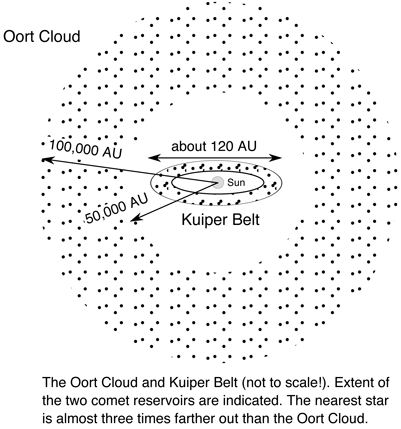
Comets can be divided into two basic groups depending on their orbital periods. There are long period comets with orbital periods that can be thousands to millions of years long, and short period comets with orbital periods less than about 200 years. Their alignments with the plane of the planet orbits is also different. The long period comet orbits are oriented in all different random angles while the short period comets orbits are within about 30 degrees of the solar system plane (ecliptic). These orbital characteristics point to two regions beyond the realm of the planets: the Oort Cloud and the Kuiper Belt.
At the great distances of the Oort Cloud, comets can be affected by the gentle gravitational tugs of nearby passing stars. The passing stars tug on the comets, “perturbing” their orbits, sending some of them into the inner solar system. The comets passing close to a Jovian planet are deflected by the planet's gravity into an orbit with a shorter period, only decades to a few thousand years long. Jupiter and perhaps Saturn tend to deflect long period comets completely out of the solar system (or gobble them up as Jupiter did with Shoemaker Levy-9). Uranus and Neptune tend to deflect the long period comets into orbits that stay within the solar system. Halley's Comet may be an example of a deflected comet. Unlike other short period comets, Halley's Comet's orbit is retrograde.
The Oort cloud comets probably formed 4.6 billion years ago at about the same distance as where Saturn and Uranus are today from the Sun and were then deflected outward when they passed close to the large planets. Comets forming at the distance of Jupiter were either ejected from the solar system by the massive planet in a “gravitationally slingshot” or gobbled up. Comets forming further out than Neptune's current position never coalesced to form a planet and now make up the Kuiper Belt.
If our Jovian planets can fling comets out of the Solar System, then Jovian planets in other planetary systems can do the same thing and some of those interstellar objects can eventually find their way to our Solar System. These objects will move through our solar system at very high speeds in hyperbolic orbits, unbound to the Sun. Because they are rare, move quickly, and usually don't come into the inner solar system where we are, it wasn't until October 2017 that we discovered our first interstellar object called ‘Oumuamua. It is unusually long and skinny: 10 times longer than it is wide (the most elongated comet/asteroid we had seen before had just a 3-to-1 ratio). ‘Oumuamua exhibited very little activity when it neared the sun. The second interstellar object Comet 2I/Borisov discovered (in August 2019) was the first confirmed interstellar comet. A lot of telescopes were pointed at Comet 3I/ATLAS (C/2025 N1) in late 2025 and early 2026 as it zipped through the inner Solar System, getting to within Mars' orbit. As our search techniques improve, we will probably find one or two interstellar objects every year.
Using the observed characteristics of the short period comet orbits, the Dutch-American astronomer Gerard Kuiper proposed the existence of a disk of 100's of millions of comets from 30 to 100 or more A.U. from the Sun orbiting roughly along the ecliptic. This belt of comets is called the Kuiper Belt or sometimes the Edgeworth-Kuiper Belt after the British astronomer who also proposed its existence even earlier than Kuiper but unknown to Kuiper. The Kuiper Belt was first observed in 1992. Comets originally from the Kuiper Belt that pass near the Earth have perihelia around the terrestrial planets' distances from the Sun and aphelia a bit beyond Neptune. Interactions with Neptune and Uranus have made their orbits so elliptical. Some examples are Comet Hartley 2 (103P), Comet Encke (2P), Comet Giacobini-Zinner, and the former Comet Shoemaker-Levy 9.
The comets observed in the Kuiper Belt have more circular orbits and do not stray close to Uranus or Neptune. Many of the Kuiper belt comets observed from the ground are 100 to 300 kilometers in size (but some are Pluto-size) and orbit between 30 and 60 A.U. from the Sun. Another group of objects mostly between Saturn (9.5 A.U.) and Uranus (19.2 A.U.), called “Centaurs”, may be an extension of the Kuiper Belt. These objects include Chiron (170 kilometers in diameter) and Chariklo (about 240 kilometers in diameter) and many others.
Further out than the 50 or 60 A.U. limit of the Kuiper Belt is a sort of transition zone between the Kuiper Belt and the inner part of the Oort Cloud called the “scattered disk” that includes objects with larger, more eccentric orbits and larger orbit inclinations (angles with respect to the ecliptic) than Kuiper Belt objects. These objects include Eris (about 2300 kilometers in diameter and an elliptical orbit between 38 A.U. and almost 98 A.U.) and Sedna (about 1000 kilometers in diameter and an elliptical orbit between 76 A.U and almost 940 A.U.). On its 1996-97 visit to the inner solar system, Comet Hale-Bopp had its orbit changed by Jupiter so it now spends most of its time in the scattered disk with an aphelion about 370 A.U. and an orbital period of about 2500 years. Scattered disk objects are probably the result of gravitational interactions with Uranus and Neptune.
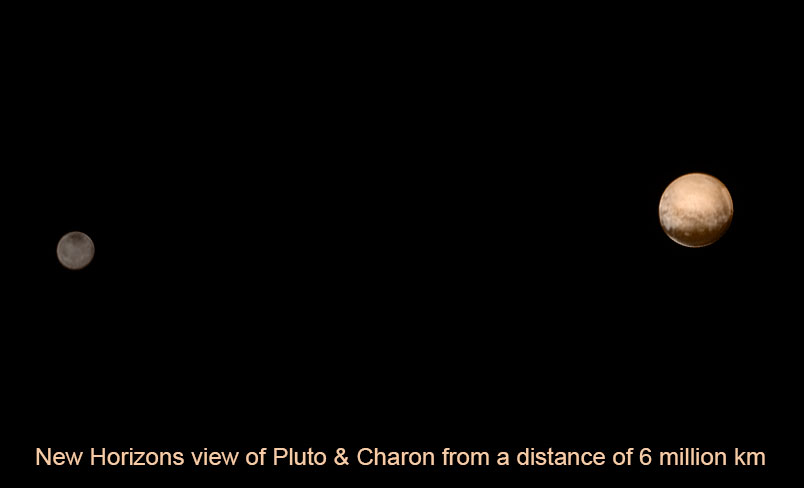
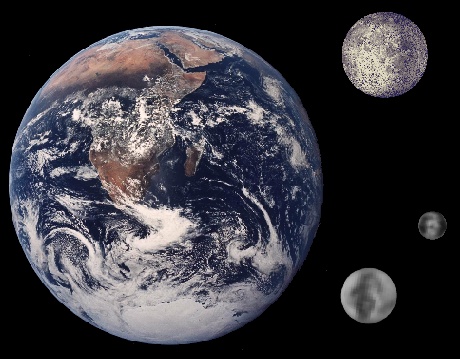
The discovery of Pluto's large moon, Charon, in 1978 and then the five-year period of eclipses as Charon's orbit lined up with our line of sight between 1985 and 1990, enabled us to downsize Pluto's diameter and mass considerably. Because of its small size and low density, some astronomers came to view Pluto (2330 kilometers in diameter and just 1/6th our Moon's mass; on the right in the image above) as just a large comet. In addition to its size and density, the orbital characteristics of Pluto and its moon Charon (1200 kilometers in diameter; on the left in the image above) around the Sun clearly show that they are members of the Kuiper Belt. (Pluto is now known to have at least four other smaller moons orbiting it.)
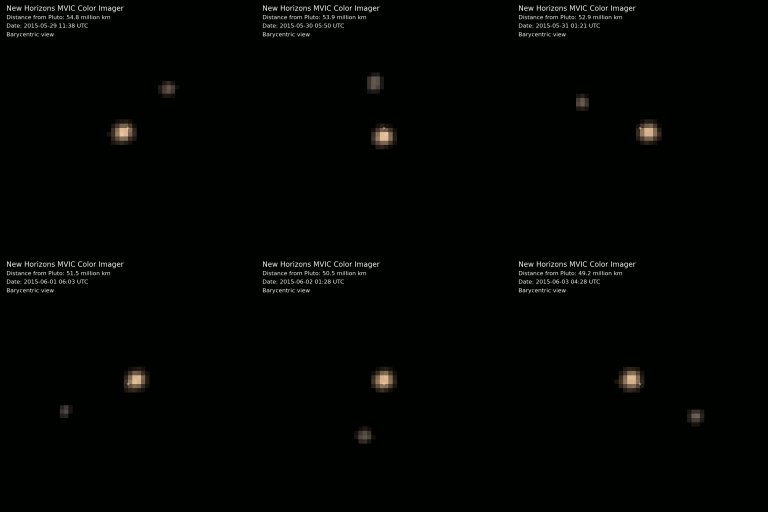
The GIF animation on the left is Pluto as seen by the Hubble Space Telescope using images released Feb. 6, 2010 . The GIF animation on the right shows Pluto and Charon orbiting their center-of-mass (“barycenter”) while New Horizons was still about 50 million miles away (link to full-resolution 1000 pixel version).
 --
-- 
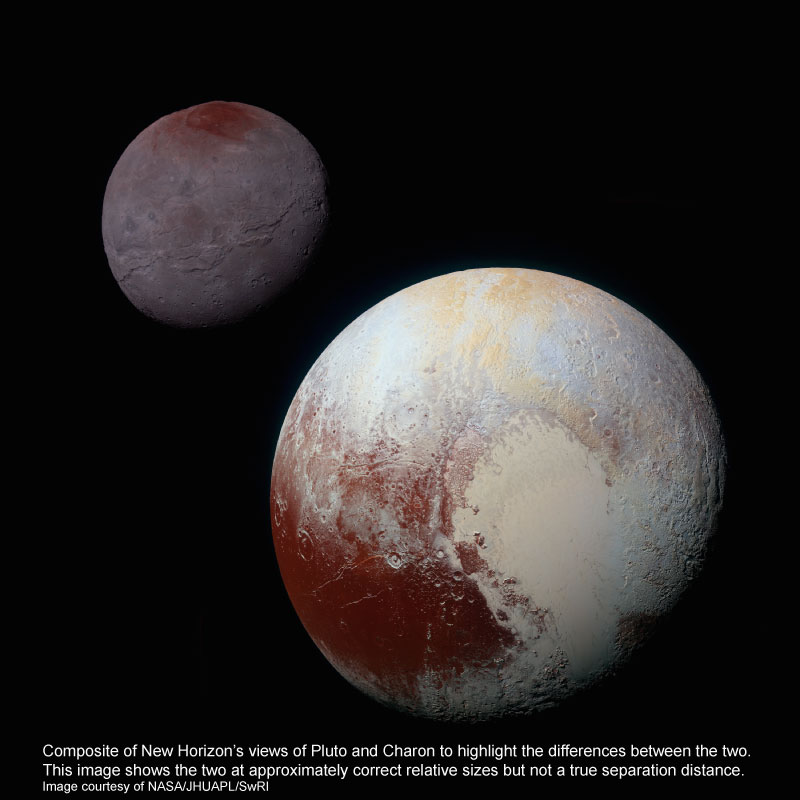
In July 2005 the discovery of a scattered disk object larger than Pluto was announced, called Eris (formerly UB 313). Is Eris the tenth planet? If Pluto is a planet, should not Eris be considered a planet too? How about Ceres in the asteroid belt? Although the discovery of a Kuiper Belt object the size of Pluto or larger was considered likely, Eris' discovery finally forced astronomers to decide what is to be called a “planet”, what is a “minor planet”, what is an “asteroid”, “large comet”, etc. (Note that more recent measurements of Eris say that it is about the same diameter as Pluto but 20% larger in mass. It doesn't change the “planet” definition problem.)
On August 23, 2006, the International Astronomical Union (IAU, the official authority responsible for naming stars, planets, celestial bodies and phenomena, etc.—the official body of astronomy) re-classified Pluto as a “dwarf planet”. A “planet” in our solar system is a celestial body that “(a) orbits the Sun; (b) has sufficient mass for its self-gravity to overcome rigid-body forces so that it assumes a hydrostatic equilibrium (nearly round) shape; and (c) has cleared the neighborhood around its orbit.” Pluto fits (a) and (b), but not (c). Pluto, Eris, Ceres, and others will be called “dwarf planets” because although they fit (a) and (b), they have not cleared the neighborhood around their orbits. Also, a “dwarf planet” is not a satellite (which may leave out Charon, but its large mass compared to Pluto may make Charon to be a “dwarf planet”).
The third criteria (c) of a planet from the IAU has caused a considerable amount of debate—what does “cleared the neighborhood around its orbit” mean? One interpretation is to say that the object gravitationally dominates its orbital zone where an orbital zone includes all objects whose orbits cross each other, their orbital periods differ by less than a factor of 10, and they are not in a stable resonance. Within that orbital zone, if a round object is much more massive (say, by at least 100 times) than the other objects combined mass, it will gravitationally dominate its zone. With this interpretation there is a clear separation between the eight “planets” (Mercury, Venus, Earth, Mars, Jupiter, Saturn, Uranus, and Neptune) and the “dwarf planets”. All eight planets are at least 5000 times more massive than the other objects in their orbital zones while Pluto is only 0.07 times the mass of the rest of the objects in its orbital zone (Ceres is just 0.33 times the mass of the rest in its orbital zone). At the time of writing, Haumea and Makemake were the only others that had been officially recognized by the IAU as “dwarf planets”. However, any body made mostly of ices larger than about 400 kilometers will be round, so the number of dwarf planets is undoubtedly much larger. By the time all of the bodies in the Kuiper Belt and scattered disk are found, the number of dwarf planets will probably number well over 200. See Mike Brown's “The Dwarf Planets” page for more about dwarf planets and their number (he is the discoverer of Eris).
Even smaller objects (comets, most asteroids, etc.) will be called “Small Solar System Bodies”. This does leave open the question of how this applies to planets outside the solar system, especially the truly planet-sized objects that are not bound to any star. Another controversial issue behind the IAU 2006 decision was the small proportion of members who voted on the decision. After the initial series of arguments following the 2006 decision, over time the astronomers came to accept the decision and the planet definition issue did not even come up at the IAU 2009 and 2012 meetings.
From a planetary geologist's perspective, the crucial measure of a planet, dwarf planet, or moon is its diameter. An object large enough for its own gravity to make it round will also have had enough internal heating to create the geologic activity necessary to reshape its surface from its initial formation 4.6 billion years ago. Also, the internal heating will mean the object has undergone differentiation where the heavier materials have sunk to the core and the lighter materials have risen nearer to the surface. For example, Pluto has a surprisingly geologically complex surface (see also and this also) for such a small world, second only to Earth in its diversity: from mountain ranges to smooth plains and nitrogen ice glaciers that appear to still be active, as well as, cryo-volcanism that may also still be active. Indeed, Pluto has shown us why we explore. Reality is so much cooler than what we can program in our virtual worlds because nature is far more creative than we are. (Left image below link -- right image below link)
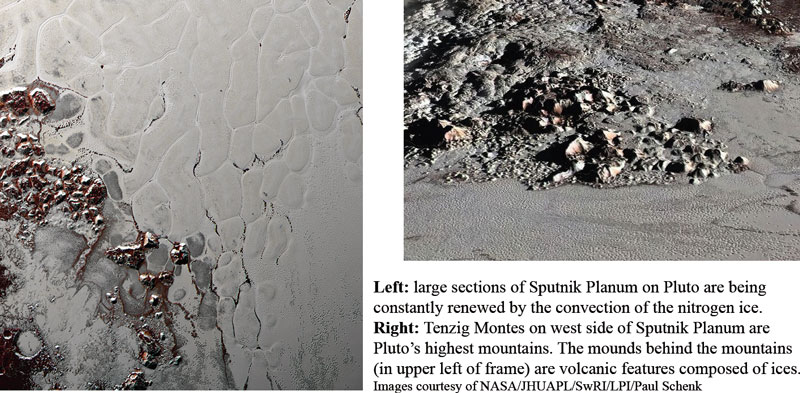
Technically, the crucial measure should be the object's mass as in the IAU definition above but the diameter of a solar system object can usually be determined more quickly than its mass. The diameter can be determined from as little as a single image while mass determination requires multiple observations of how the object accelerates the motions of other bodies near it. In addition, solid objects of sufficient diameter and made of typical sorts of material will have enough mass to create some interesting geology. Finally, the use of either of the intrinsic properties of mass or diameter is much easier (practical) than whether or not the object has cleared its neighborhood when studying exoplanets.
The image below compares Pluto, Charon to Earth and the Moon. Eris is probably the same diameter as Pluto, so it is still smaller than the Moon. In mid-January 2006, the New Horizons spacecraft was launched on a 9.5-year trek to Pluto-Charon. After flying by Pluto-Charon in July 2015, it was directed to Kuiper Belt Object 2014 MU69, “Arrokoth”. It flew by Arrokoth on January 1, 2019. Arrokoth is the first unquestionably primordial contact binary ever explored—the two lobes once orbited each other until something made them gently merge. It is 35 kilometers long and the larger lobe has twice the volume of the smaller lobe.
 --
-- 
(Left) Earth, Moon, Pluto and Charon to the same scale (using images from NASA and
USGS)
(Right) Arrokoth as seen by New Horizons (Arrokoth is only 35 kilometers long)
The currect list of objects of the Kuiper Belt is at the Minor Planets Center. They keep a list of the trans-Neptunian objects and a list of the Centaurs. A plot of the positions of the observed Kuiper Belt objects is also available from the Minor Planets Center.
Regardless of where it is in the solar system, the Sun's gravity is always pulling on the comets. When a comet is close to the Sun, it moves quickly because of the great force of gravity it feels from the Sun. It has enough angular momentum to avoid crashing into the Sun. Angular momentum is a measure of the amount of spin or orbital motion an object or system of objects has—see appendix A for more on angular momentum. As a comet moves away from the Sun, the Sun's gravity continually slows it down. Eventually, the comet slows down to the aphelion point and the Sun's gravity pulls it back.
A comet's motion around the Sun is sort of like a swing on the Earth. When the swing is closest to the ground, it moves quickly. As the swing moves up, the Earth's gravity is continually pulling on it, slowing it down. Eventually, the swing is slowed down so much that it stops and the Earth's gravity pulls it back down. The swing has enough angular momentum to avoid crashing to the ground.
 Go back to previous section --
 Go to next section
last updated: June 6, 2026