Comets formed 4.6 billion years ago along with the rest of the planets from the same solar nebula material. They were too small and cold to undergo any geologic activity (they did not differentiate), so they preserve the record of the early solar nebula composition and physical conditions. Those forming near the Jovian planets were deflected outward, swallowed up or sent careening inward toward the terrestrial planets and the Sun. Some of the water now present on the terrestrial planets may have come from comets crashing into them.
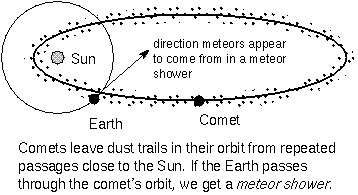
Short period comets make hundreds to thousands of passes around the Sun spewing out gas and dust. Over time a comet will leave bits of dust along its orbit, each piece of dust has an orbit close to the comet's orbit. The dust grains are the size of a grain of sand or smaller. If the Earth passes through the comet's orbit, the dust grains can hit the Earth's atmosphere to make the spectacular displays called meteor showers. After many passages around the Sun, the nucleus has no more volatile material and it becomes “dead.” Some asteroids are former comets.
The famous Perseid meteor shower in mid-August is due to Earth passing through the orbit of Comet Swift-Tuttle and the Leonid meteor shower in mid-November is due to Comet Tempel-Tuttle. The meteor showers appear to be coming from a particular direction in the sky, so the meteor showers are named after the constellation they appear to be coming from. The divergence from a point in the sky (called the “radiant”) is from the same geometric effect you see of straight railroad tracks or the edges of a straight road spreading out toward you from a distant point far away on the horizon. The Perseids appear to diverge from the Perseus constellation and the Leonids diverge from Leo. When the parent comet passes through the inner solar system, the meteor shower display is particularly impressive—several hundred meteors can be seen in one hour. Such events are called meteor storms. The last storm was for the Leonids in 2002. While most comet dust particles in meteor showers hit the atmosphere at 30 to 40 kilometers/second, the Leonid particles hit our atmosphere at 72 kilometers/second. The table summarizes the characteristics for several impressive showers. A meteor shower will cover a time period of several days before and after the given maximum date.
| Meteor shower | Max. Date | Meteors per hour |
constellation RA :: Dec |
comet source |
Meteor speed |
|---|---|---|---|---|---|
| Quadrantids | Jan. 3 or 4 | 40 to 110 | Bootes, Hercules, Draco 15h 28m :: +50° |
2003 EH1 | 25.5 miles/sec (41 km/sec) |
| Lyrids | Apr. 21 to 22 | 8 to 12 | Hercules-Lyra 18h 16m :: +34° |
C/1861 G1 Thatcher | 30 miles/sec (49 km/sec) |
| Eta Aquarids | May 5 to 6 | 5 to 20 | Aquarius 22h 24m :: 0° |
Comet Halley | 41 miles/sec (66 km/sec) |
| Delta Aquarids | Jul. 28 to 29 | 15 to 35 | Aquarius 22h 36m :: --17° |
? (maybe 96P Machholz) | 25 miles/sec (41 km/sec) |
| Perseids | Aug. 11 to 12 | 40 to 70 | Perseus 03h 04m :: +58° |
Comet 109P/Swift-Tuttle | 37 miles/sec (59 km/sec) |
| Orionids | Oct. 21 | 13 to 30 | Orion 06h 20m :: +15° |
Comet Halley | 41 miles/sec (66 km/sec) |
| Taurids | Nov. 1 to 8 | 5 to 12 | Taurus 03h 32m :: +14° |
Comet Encke | 17 miles/sec (28 km/sec) |
| Leonids | Nov. 17 | 6 to 10 | Leo 10h 08m :: +22° |
Comet 55P/Tempel-Tuttle | 44 miles/sec (72 km/sec) |
| Geminids | Dec. 13 to 14 | 50 to 70 | Gemini 07h 32m :: +32° |
3200 Phaethon (inactive comet?) |
22 miles/sec (35 km/sec) |
More on meteor showers from:
The meteors not associated with a meteor shower are bits of rock from asteroids. The meteors that ARE associated with a meteor shower are much too fragile to survive their trip through our atmosphere and burn up at altitudes above 50 kilometers. Some of the comet dust intercepts the Earth at much slower speeds than those making the meteors and can make its way to the surface gently. Don Brownlee, an astronomer at the University of Washington has pioneered the collection of this comet dust in the stratosphere. More information about the comet dust samples is available at the Stratospheric Dust web site at the Planetary Materials Curation office of NASA.
 Go back to previous section --
 Go to next section
last updated: June 6, 2026