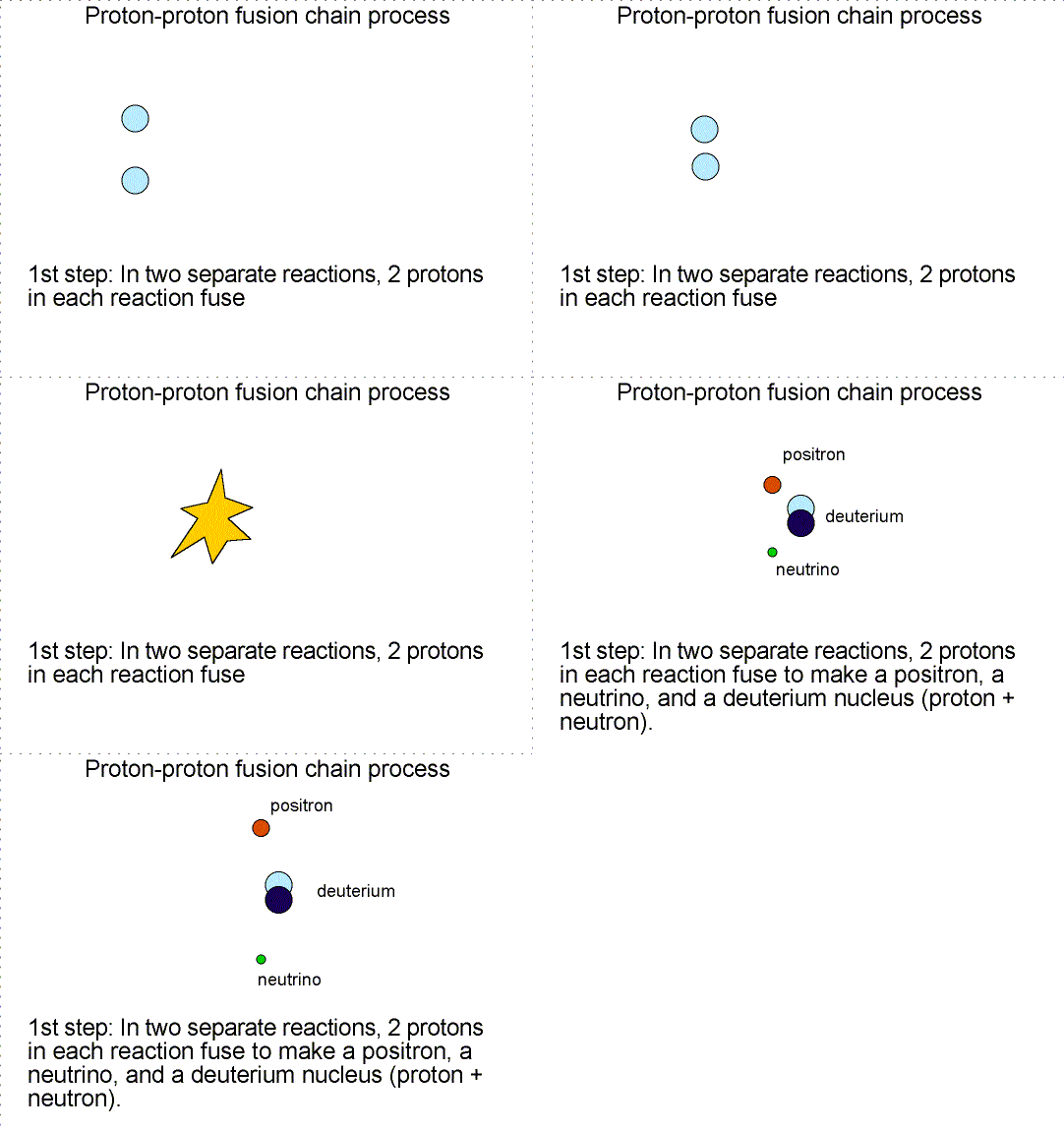
Helium is produced in the fusion of hydrogen. As shown in the proton-proton fusion chain diagram above, there are two other particles produced. One is the “positron” and the other is a “neutrino”. A positron is the antimatter counterpart of the electron. It has the same mass as an electron but the opposite charge. When it collides with an electron, they annihilate each other converting all of their mass into energy.
The photons produced in nuclear reactions take about a million years to move from the core to the surface. The photons scatter off the dense gas particles in the interior and move about a centimeter between collisions. In each collision they transfer some of their energy to the gas particles. By the time photons reach the photosphere, the gamma rays have become photons of much lower energy—visible light photons. Because the photons now reaching the surface were produced about a million years ago, they tell us about the conditions in the core as it was a million years ago. The other particle produced in nuclear reactions has a less tortuous path out of the core.
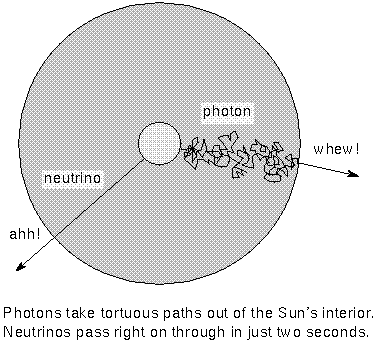
A neutrino is a very low-mass particle that rarely interacts with ordinary matter. Neutrinos travel extremely fast—slightly less than the speed of light. Because they travel so fast and interact so rarely with matter, neutrinos pass from the core of the Sun to the surface in only two seconds. They take less than 8.5 minutes to travel the distance from the Sun to the Earth. If you could detect them, the neutrinos would tell you about the conditions in the Sun's core as it was only 8.5 minutes ago (much more current information than the photons!).
The problem with neutrinos is that they have a very low probability of interacting with matter. A neutrino could pass through a light year of lead and not be stopped by any of the lead atoms! However, there are A LOT of neutrinos produced by the Sun. Take a look at your pinky finger. In one second several trillion neutrinos passed through your pinky (did you feel them?). Do not worry, the neutrinos did not damage anything. The great majority of neutrinos pass right through the materials around you.
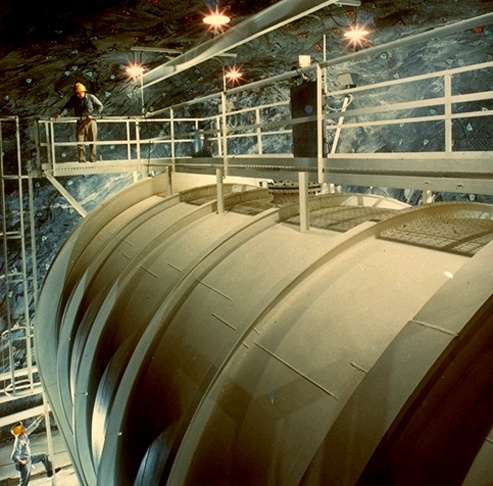
Homestake
Gold Mine Neutrino Experiment (courtesy of R. Davis, Brookhaven National
Laboratory).
A few of them will interact with some matter on the Earth. You can increase the odds of detecting a few of them by using a LARGE amount of a material that reacts with neutrinos in a certain way. A chlorine isotope will change to a radioactive isotope of argon when a neutrino interacts with it. In the same way a gallium isotope will change to a radioactive isotope of germanium. Water molecules will give off a flash of light when struck by a neutrino. Neutrino detectors use hundreds of thousands of liters of of these materials in a container buried under many tens of meters of rock to shield the detectors from other energetic particles from space called cosmic rays. Even the largest detectors detect only several hundred neutrinos in a year (compare that to the trillions of neutrinos that pass through you every second).
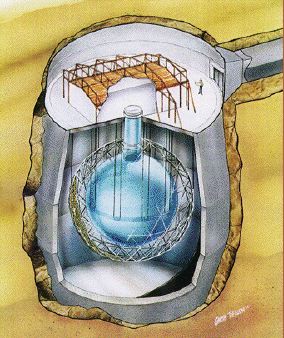 Sudbury Neutrino Observatory |
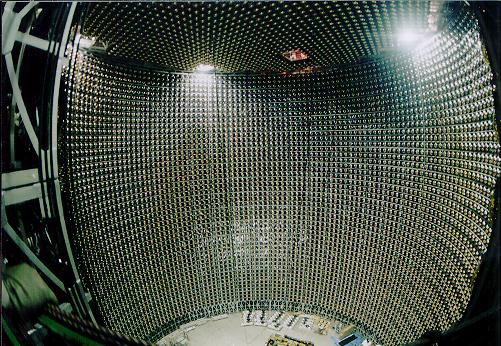 Super-Kamiokande Neutrino Detector water tank showing the thousands of photon detectors each about the size of a beach ball. |
Nuclear fusion is not the Sun's power source. This reason was not supported by other observations, so it was not likely to be the correct reason.
The experiments were not calibrated correctly. It was unlikely that all of the carefully-tuned experiments were tuned in the same wrong way. The experiments used three very different ways to detect neutrinos and produced the same lack of neutrinos. The experiments were independently verified by many other scientists, so astronomers think that the results are correct, even if they were disappointing.
The nuclear reaction rate in the Sun is lower than what our calculations say. This was possible but many people checked and re-checked the physics of the reaction rates. There are some strong constraints in how much you can lower the temperature in the core of the Sun to slow down the reactions. Astronomers know how much total energy is emitted by the Sun, so they know very accurately how many nuclear reactions are needed to produce all of those photons seen coming from the Sun. Those reactions also produce the neutrinos. Astronomers think they have a good idea of how stars produce their energy. That left another alternative.
Neutrinos produced in the core of the Sun change into other types of neutrinos during their flight from the Sun to the Earth. Our neutrino detectors can detect a certain kind of neutrino, called the “electron neutrino”, that are produced from nuclear fusion. Some of these electron neutrinos may change into another of two types of neutrino (the “muon neutrino” or the “tau neutrino”) that do not interact with the detection material as well as the electron neutrino. Some experiments in high-energy particle accelerators and the water tank Super-Kamiokande neutrino detector (Japan) suggested that the neutrinos could change into other types. The Sudbury Neutrino Observatory (Canada), using almost 900,000 liters of heavy water, was built to detect all three types of neutrinos. It firmly established that some of the electron neutrinos produced by the nuclear fusion in the Sun do change into the other neutrino types and that the solar nuclear fusion models do predict the correct number of neutrinos. It looks like the 30-year mystery has been solved! The chief scientists for the Super-Kamiokande and the Sudbury Neutrino Observatory received the 2015 Nobel Prize in Physics for their discovery of neutrino oscillation.
A neutrino can change into another type of neutrino only if the neutrino has some mass. If the neutrino has mass, then it cannot travel at the speed of light, but it can get darn close. Recent experiments have shown that the neutrino does have a tiny amount of mass (several million times less than an electron). A neutrino with even as small a mass as this has important consequences for the evolution of the universe (more about that later) and our understanding of the structure of matter. It is amazing that in their effort to check their nuclear fusion theory, astronomers have learned totally unexpected things about fundamental physics and this has changed what is known about the structure and behavior of the entire universe itself. Wow!
Two other sites worth exploring about neutrinos follow:
 Go back to previous section --
 Go to next section
last updated: June 14, 2026